Cline enterprise security: reduce approval fatigue without delegating unlimited authority
 Cline7 min readBusiness
A CISO and VP engineering guide to Cline auto-approval, developer workflow design, and an honest detection-only Leash coverage assessment.
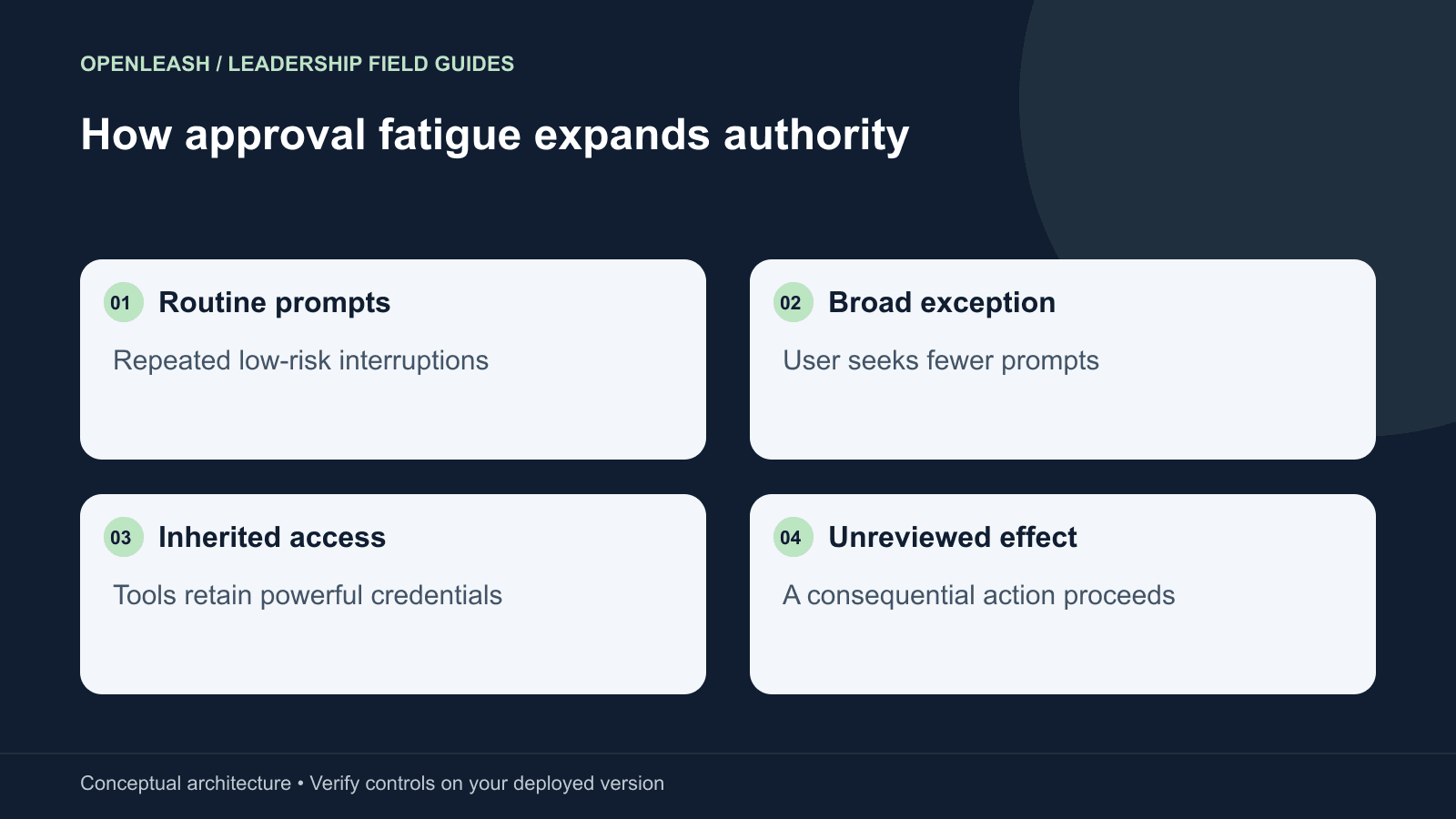
Approval fatigue is a workflow problem with security consequences. If every ordinary action interrupts a developer, broad auto-approval can become the easiest way to finish work. Leaders need to distinguish routine development from consequential actions and build an environment where useful autonomy does not require unrestricted credentials.
In this guide
Diagnose the workflow before changing the permission policy
When developers ask to disable approvals, the request often contains useful product feedback. They may be interrupted for repetitive reads, tests, or edits in a disposable workspace. Treating every request for fewer prompts as disregard for security misses the opportunity to design a better operating model.
Ask a pilot team to record where interruptions occur and what the actions can affect. Separate harmless local work from actions that publish, modify shared systems, access sensitive data, or change security controls. The distinction should be based on actual authority and consequence, not simply whether a command looks familiar.
The VP of engineering should own the usability of the approved workflow. The CISO should define the boundaries that cannot be removed for convenience. Platform engineering should provide an environment in which routine tasks have limited consequences. This shared responsibility is more durable than a policy that tells developers to approve carefully while leaving them with an unrestricted workstation and hundreds of prompts.
Understand Cline’s native auto-approval choices
Cline documents auto-approval controls for categories of activity and broader autonomy options. The selected settings change how often the user is asked before the agent proceeds. Review the exact behavior in the version and mode you deploy; do not assume that a teammate’s configuration or an older screenshot describes the current installation.
Auto-approval is an authorization choice, not a reduction in the underlying tool’s power. If a tool can reach a live service through an inherited credential, fewer prompts do not make that access less consequential. Conversely, a tightly limited environment can make some autonomous development work reasonable because the available effects are deliberately small.
Document the approved settings alongside the environment assumptions. A configuration accepted for a disposable repository without production credentials should not automatically be reused on an administrator’s workstation. When those assumptions change, the approval decision needs to be revisited rather than carried forward by habit.
A hypothetical failure: the test command has a second effect
Consider a fictional repository where an ordinary test script is changed to upload diagnostics after running tests. A developer has broadly approved the familiar test workflow. The agent invokes it to complete a legitimate task, but the script now has an external effect that was absent when the workflow was originally accepted.
The issue is composition. A short command can delegate to scripts, packages, and subprocesses whose behavior changes over time. A policy based only on the visible command name can miss those changes. Review executable project configuration and keep outbound destinations and credentials constrained independently.
Build a sample test script that writes a marker to a local mock endpoint rather than sending real data. Verify whether the approved workflow notices the new effect and whether the environment permits it. The exercise should establish the limits of the native approval setup and the independent controls. It should not be described as a demonstrated vulnerability in Cline; it is a general governance scenario for delegated script execution.
Be precise about Leash’s current Cline coverage
Leash currently lists Cline as detection-only. There is no installable Cline action-protection path in the published coverage matrix. Detection can help identify agent presence, but it must not be presented as proof that Cline commands are intercepted, blocked, or routed through Leash approvals.
For a CISO, this is still useful information: it separates the discovered estate from the protected estate and identifies a deployment that needs other controls. Leash can contribute to an agent inventory and provide supported action protection for other enrolled agents in the organization. It does not solve Cline’s pre-execution control requirement merely by detecting the application.
If action enforcement through Leash is a mandatory condition for a specific workflow, keep that Cline workflow outside the approved scope until a supported integration is available and validated, or use an agent with an appropriate verified integration. This is a procurement and architecture decision, not a reason to relabel detection as protection.
Run a pilot that measures both autonomy and containment
Choose a bounded development task in a repository with synthetic data. Remove production credentials and unrelated secrets from the environment. Give the developer a clear route to request additional access when necessary, because an unexplained block often leads to a workaround outside the pilot.
Start with the native approval settings your team intends to support. Record task completion, interruption count, the context shown to the reviewer, and any action performed outside the approved workflow. Then make one narrow adjustment and repeat the task. This reveals whether the usability improvement comes from reducing unnecessary prompts or from silently expanding consequential authority.
- Baseline task: complete a normal edit-and-test cycle and record where human decisions add value.
- Sensitive fixture: attempt a harmless out-of-scope file or service action and verify the native or environmental boundary.
- Script change: add a mock secondary effect to a sample command and observe the result.
- Credential check: confirm the process cannot access unrelated production identities.
- Release check: verify that creating a patch does not grant merge or deployment authority.
- Coverage record: label Cline as detected, with no asserted Leash action enforcement, in the pilot report.
Replace broad exceptions with better task lanes
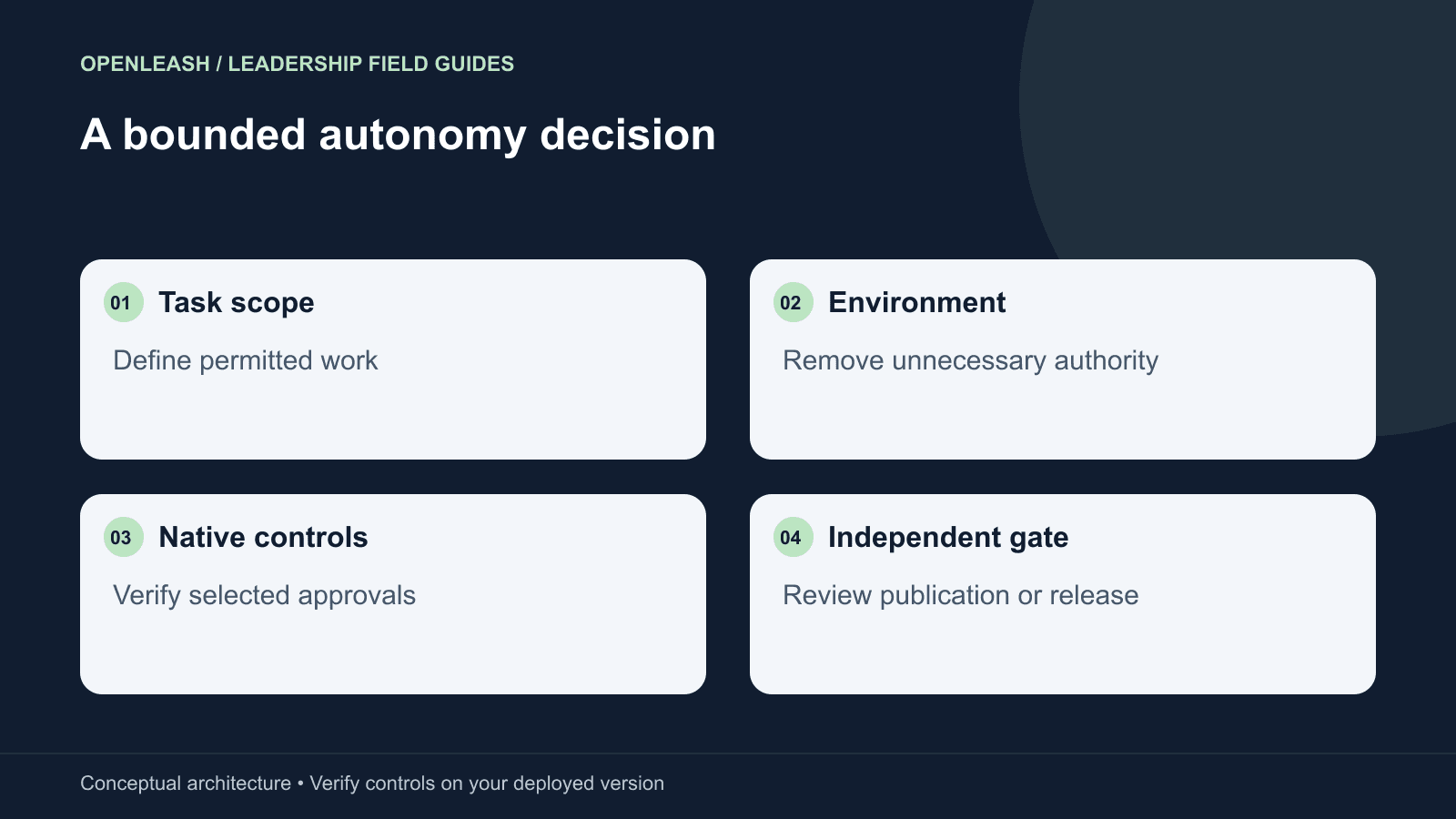
A useful development lane has a defined workspace, tool set, credential scope, and output. For example, an agent may prepare a patch and run local tests, while a separate process reviews and releases it. This lets the team allow meaningful work without deciding that every action from the developer’s identity is acceptable.
Create a second lane for tasks that genuinely require more authority. Require a named owner, a specific purpose, limited duration, and an explicit review of the affected system. Keep the ordinary lane available so exceptional access does not become the default environment for the rest of the day.
The organization should also define how to handle repeated approval requests. If a task asks for the same consequential permission many times, investigate the workflow rather than issuing a permanent broad exception. It may be possible to prepare one reviewable artifact, use a narrower service operation, or move the final action into an established release process.
Give the board an honest coverage and productivity report
Report discovered agents, approved use cases, verified controls, and unresolved gaps separately. For Cline, the Leash coverage entry should explicitly say detection-only. Native approval tests and environmental restrictions can be listed as separate evidence with their own owners. This prevents a single green dashboard label from obscuring different levels of assurance.
Measure the time to a useful reviewed patch, reviewer effort, exception frequency, and attempted use of unavailable credentials. Track whether developers leave the approved environment to finish work. That behavior is a signal that the platform needs improvement, and it is more actionable than simply counting prompts accepted.
A pilot is ready to expand when the team can explain its effective authority and demonstrate the relevant boundaries. It is not ready merely because no incident was observed during a short trial. Use the test results to identify which additional repositories, data classes, or identities would change the risk assessment before adding them.
Questions for the CISO and VP of engineering
Should all auto-approval be prohibited? The answer depends on the task and environment. Bounded work with limited authority can justify a different policy from operations on shared production systems. Make that decision explicit and testable.
Does detecting Cline in Leash stop risky Cline actions? No. Current coverage is detection-only, so use verified native and independent controls and keep the enforcement gap visible.
What should leadership do next? Sponsor one contained Cline pilot, assign a platform owner, and compare task quality with the cost of human review. Publish the approved environment and its limits. That gives developers a practical route to useful autonomy while preserving an honest account of what the organization can currently control.