Continue enterprise security: a private model does not settle tool authorization
 Continue7 min readBusiness
A CTO and CISO guide to Continue deployments, private model routing, MCP tools, and the difference between data-residency decisions and action permissions.
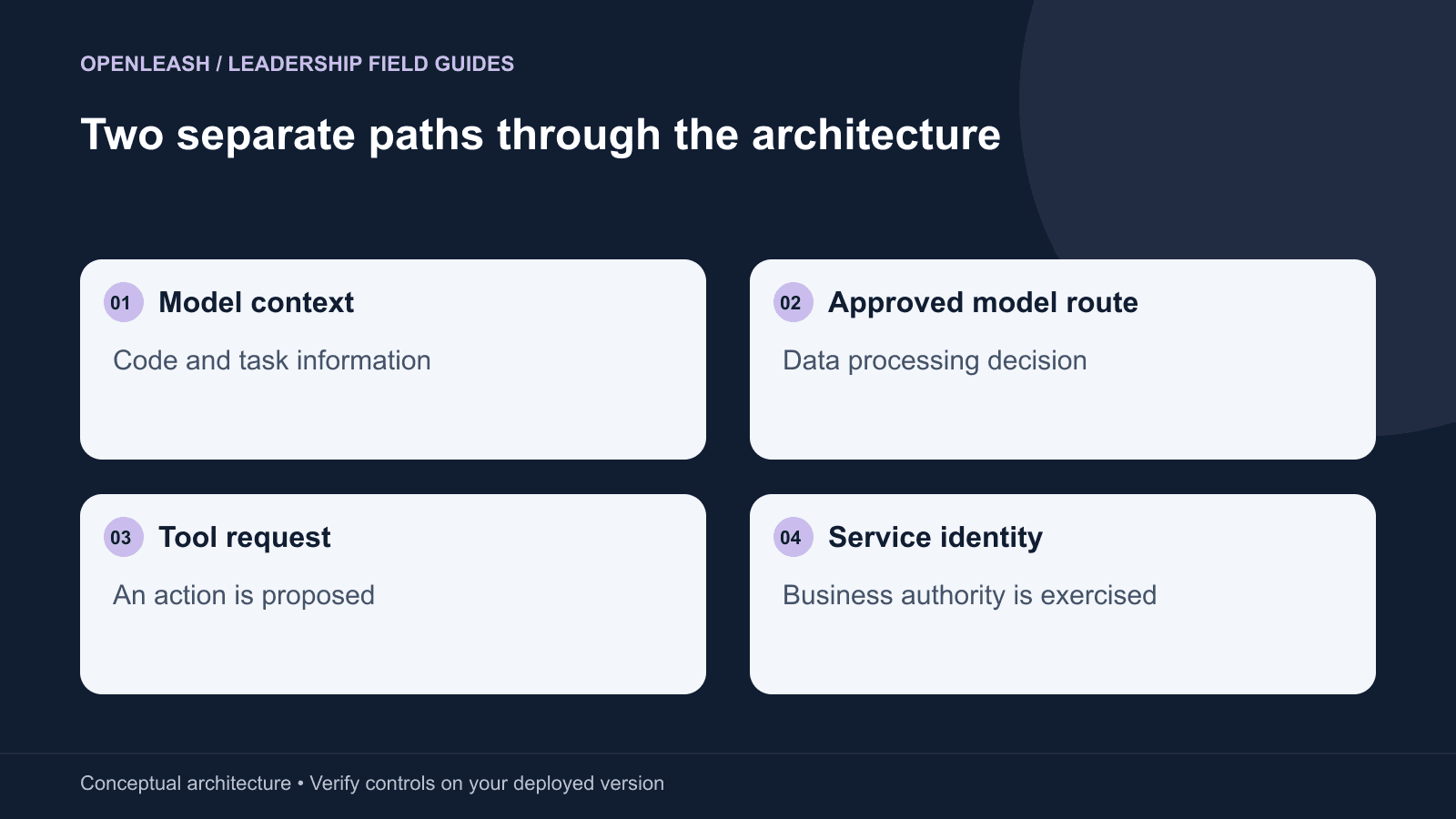
A company may choose Continue to assemble a development experience around its preferred models and tools. That flexibility makes architecture ownership essential. Keeping model traffic on an approved route answers one question; deciding which tools can act on internal systems answers another.
In this guide
Separate the private-model decision from the agent decision
A private or approved model endpoint can be an important part of an enterprise data strategy. It does not, by itself, determine whether an agent should update a ticket, change a database record, run a shell command, or publish a package. These actions depend on the tools and identities connected to the agent.
For a CTO, this means the platform architecture needs two explicit reviews. One maps the information sent to models and other services. The other maps the actions available through tools and the permissions those tools inherit. Combining the reviews into a single “private AI” approval can hide operational authority behind a data-residency decision.
Assign owners for both paths. Privacy and procurement can help assess provider terms and processing locations. Platform engineering should own the deployed client, tool configuration, and update process. Service owners should approve the authority of integrations that touch their systems. Security should review the combined boundary and the evidence that it behaves as intended.
Understand the mode and tool configuration you are deploying
Continue’s documentation distinguishes conversational use from modes that expose tools, and describes native tool permission behavior. A mode change can therefore change the system’s effective capability without changing the model endpoint. Review the installed client and selected mode rather than assuming that all uses of Continue carry the same risk.
Treat IDE and CLI deployments as separate records when their configuration, execution environment, or permission behavior differs. A control tested in an interactive editor should not be presumed to govern an unattended process. Record the version, launch method, tools, and effective settings used in each acceptance test.
The useful procurement question is not whether the product has permissions in the abstract. It is whether the organization can distribute, verify, and maintain the required settings for its chosen workflow. A native prompt is only one part of that answer; the credentials and service-side permissions remain important even when the prompt works as designed.
A hypothetical failure: the internal tool has excessive scope
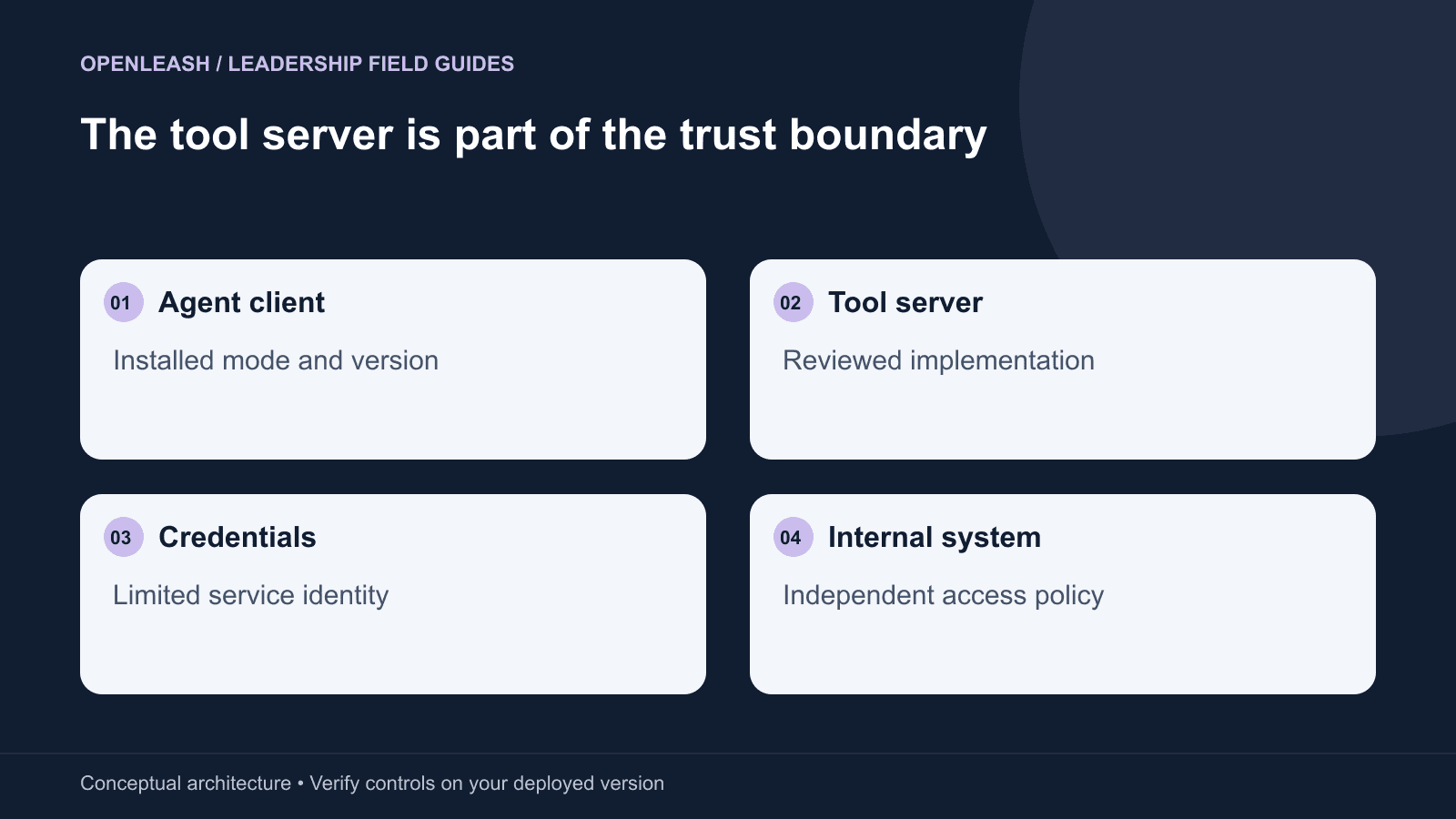
Imagine a fictional engineering assistant connected to a private model and an internal MCP server. The approved task is to summarize a test incident. The MCP server’s account, however, can update records across the live incident system. A mistaken tool request can therefore affect operational records even though the model traffic never leaves the approved route.
The problem is not a failure of private hosting. It is excessive authority in the tool integration. An internal server should not be considered low risk merely because the network destination belongs to the company. Its methods, credentials, and authorization checks determine what an agent request can cause.
Test the scenario with a mock incident service containing separate test and restricted records. Verify that the tool identity cannot modify records outside its intended scope, even if the client requests it. Then test the client’s native approval behavior separately. These two results answer different questions and should be preserved as distinct evidence.
State Leash’s Continue coverage accurately
Leash currently lists Continue as detection-only. It does not provide an installable Continue action-protection path in the published matrix. Discovering the client can help an organization understand its agent estate, but it does not establish that Continue tool calls are intercepted or subject to Leash approval.
For leadership, this distinction supports a useful coverage conversation. The inventory can show that Continue is present while the control record identifies native settings, service-side permissions, and environmental restrictions as the current enforcement mechanisms. Leash’s supported integrations for other agents should not be generalized to Continue simply because the tools serve similar purposes.
If a workflow requires Leash pre-execution protection as an acceptance criterion, treat the missing integration as an open requirement. Keep the workflow bounded under other verified controls or select an appropriately supported agent for that use case. Do not close the requirement with a detection event or a model-routing configuration that does not govern the action path.
Build a tool catalog with business ownership
For each MCP server or other tool integration, record where it runs, who maintains it, which methods it exposes, and which identity it uses. Classify methods by effect: reading, creating drafts, modifying shared records, deleting, publishing, or changing access. A single server can expose several risk levels, so approving the server name alone is insufficient.
Ask the service owner to justify the minimum required permissions. Prefer a dedicated identity over an engineer’s broad personal token. Keep test and production targets distinct and make the selected environment visible in the workflow. Document how the connection is revoked and what happens to queued or retried operations after revocation.
- Client test: confirm the installed mode exposes only the intended tool set.
- Native decision test: exercise a harmless consequential request and record the approval behavior.
- Service boundary test: attempt an out-of-scope fixture through the tool and verify independent denial.
- Data-flow test: identify model and tool destinations separately, including any external dependency used by the server.
- Upgrade test: repeat the relevant cases after client, tool-server, or permission changes.
- Coverage statement: record Continue as detected without asserting Leash action enforcement.
Design read-only access carefully before adding writes
Read-only is a valuable starting point, but it is not equivalent to unrestricted safety. A tool that reads sensitive records can place those records into model context or a generated artifact. Limit the data source to what the task needs and review where the resulting information can go. Data minimization belongs in the tool design, not only in the prompt.
For the first pilot, use sanitized records and ask for a reviewable summary. Evaluate accuracy, provenance, and the amount of human correction required. A model that confidently combines unrelated records can create business risk even without modifying the source system. Establish quality criteria before expanding access to more sensitive information.
When writes become necessary, add one operation at a time. Define the target record, permitted fields, validation, and recovery procedure. A narrow service operation is easier to govern than a general administrative interface. Where a human decision is required, ensure the workflow presents the proposed effect clearly and keeps the final authorization at a verified control point.
Give the platform team a sustainable change process
A customizable stack can accumulate many slightly different configurations. Publish a supported baseline with a small set of tools and model routes, and offer a clear process for additions. Allow experimentation in an isolated environment so innovation does not require silently modifying the production baseline.
Treat a new tool method, broader service role, or changed model destination as an architecture change. The review should focus on the new data or authority introduced, not repeat the entire product assessment. Keep the evidence linked to the deployed versions so an incident investigator can reconstruct what the system could do at the time.
Report configuration drift, ownerless integrations, expired exceptions, and tool-level access failures alongside development outcomes. These measures help the CIO understand the cost of operating the platform. A private endpoint may simplify one part of governance while a large custom tool catalog increases another; the operating model should make both visible.
Questions for the architecture review
Does a local or private model make an agent’s tools safe? No. Model processing location and tool authorization are separate decisions. Evaluate both paths and their interaction.
Does Leash currently block Continue actions? The published coverage is detection-only, so do not claim an installable action-protection integration.
What should the CTO do next? Approve one versioned client configuration, one limited tool server, and one bounded task. Test the native and service-side controls, document the Leash coverage gap, and assign owners for future changes. That produces a practical foundation for customization without confusing architectural flexibility with verified control.