Gemini CLI security: govern cloud credentials before automating operations
 Gemini CLI8 min readBusiness
A CISO and CTO guide to Gemini CLI, inherited cloud credentials, trusted folders, and safe operational automation—with a practical Leash pilot.
A terminal agent can make operational work faster because it can use tools already installed on an engineer’s machine. That same convenience can give an ordinary troubleshooting task access to cloud resources, deployment utilities, and customer data. Leaders should govern the identity behind the command before expanding the number of commands an agent may run.
In this guide
Start with the terminal’s effective authority
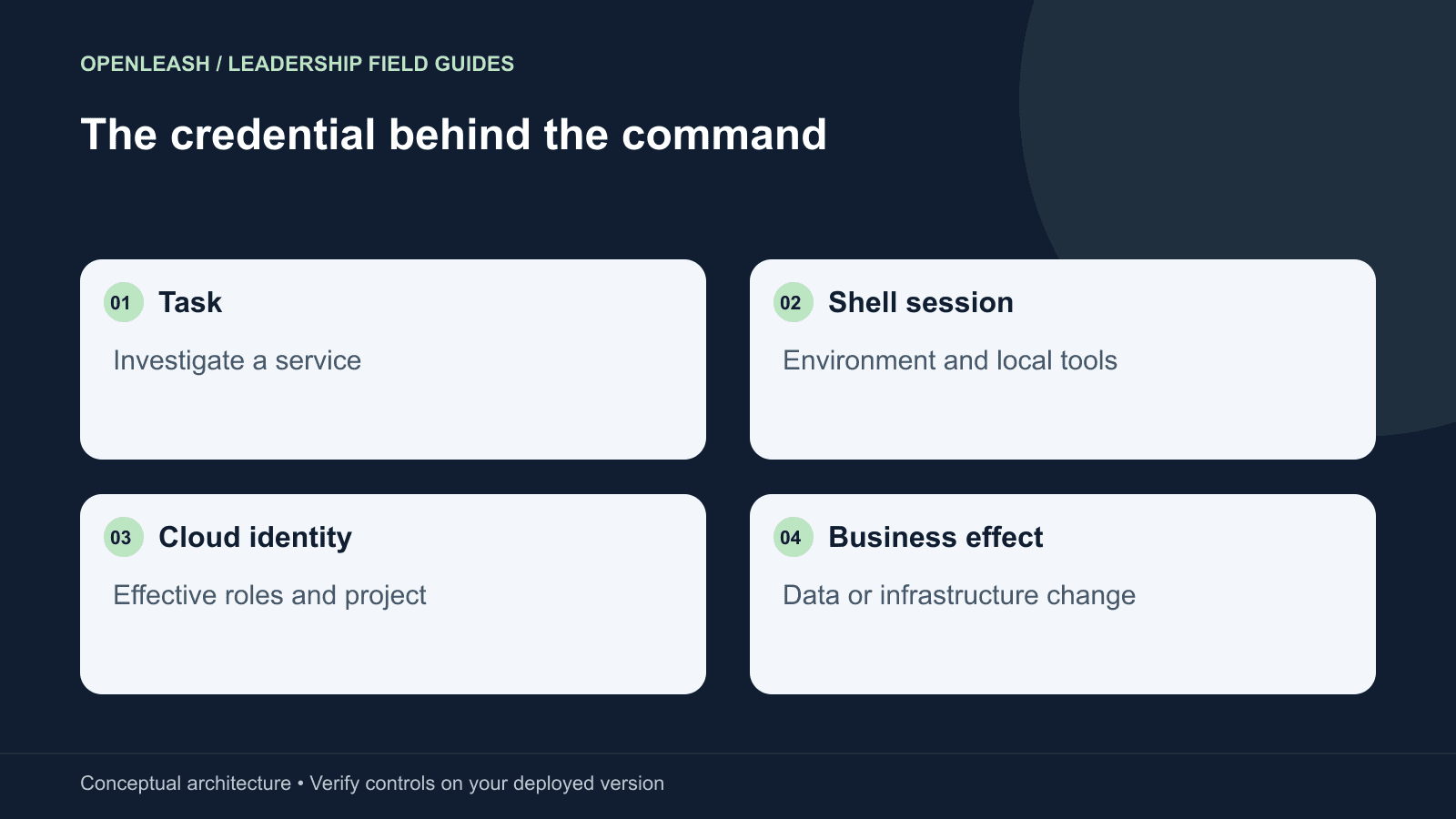
A cloud console makes the selected account visible. A terminal often makes it easier to forget. Engineers switch profiles, inherit environment variables, authenticate command-line tools, and reuse shells across projects. An agent asked to investigate a failure can encounter that accumulated authority without any business decision to delegate it.
The CTO should ask platform engineering to document a representative Gemini CLI session from process launch to resource access. Record the working directory, loaded credentials, cloud account, default project, reachable networks, installed operational tools, and any ability to obtain additional credentials. A list of approved applications will not reveal these relationships. Neither will counting how many developers installed the agent.
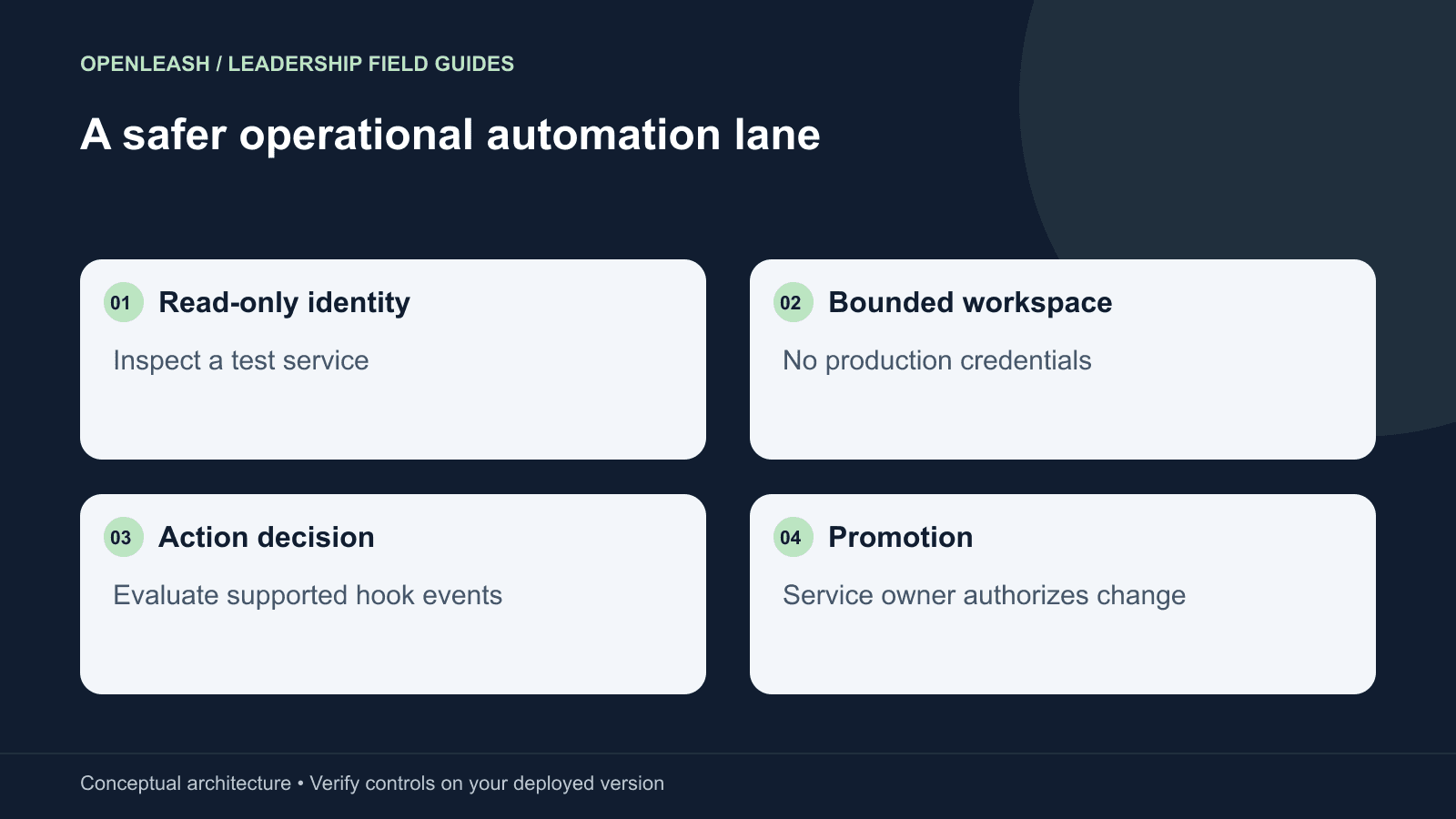
Make the inventory useful by attaching a service owner and data classification to each reachable destination. “Can run the cloud CLI” is too broad to approve. “Can read sanitized logs for one nonproduction service with a short-lived identity” describes a manageable starting point. The CISO owns the risk standard; the platform team implements the boundary; the service owner decides which operational changes are acceptable.
Understand what trusted folders and hooks actually address
Gemini CLI documents folder trust as a way to manage whether a workspace’s configuration is trusted. It also exposes hooks at defined lifecycle points. Those mechanisms address different questions: whether local configuration should influence the session, and where an integration can observe or influence agent activity. Neither is a replacement for the permissions of a cloud identity.
A trusted repository can still contain a mistaken instruction, an outdated runbook, or content copied from an external issue. Trusting the workspace should not grant every resource its tools can reach. Keep production credentials outside ordinary coding sessions and review repository-controlled configuration as executable operational input when it can launch commands or integrations.
Before relying on any hook, verify the event, payload, decision semantics, and failure behavior in the installed version. The organization needs evidence that the control runs on its actual command path. A configuration entry that was accepted without an error is a weaker result than a harmless test action visibly stopped before execution.
A hypothetical incident: the correct command in the wrong project
Consider a fictional troubleshooting task: inspect a queue in a development environment and remove abandoned test resources. The agent finds a useful maintenance script and constructs a technically valid command. The shell’s default project, however, points to a production account left over from earlier work. The command can be correct for the request’s wording and still be wrong for the business.
This scenario does not require a sophisticated jailbreak. Ambiguous environment selection and excessive identity scope are enough. Asking the model to be careful is valuable guidance, but it does not change the credential that the cloud service accepts. The decisive controls are explicit target selection, a restricted identity, and a decision before a consequential action.
Build a safe reproduction using two disposable projects or mocked endpoints with clearly different names. Give the task a development target and deliberately set a conflicting default. Observe whether the workflow resolves the mismatch, asks for clarification, or proceeds. Do not perform this exercise with real production resources. The acceptance criterion is that a wrong-target action cannot become a production change merely because the session inherited access.
Where Leash fits in a Gemini CLI deployment
Leash’s current coverage lists Gemini CLI hooks as an installable protection path. It does not list persistent full-conversation provider proxy support for Gemini CLI. This matters when explaining coverage to an executive: a hooked action path and a complete conversation routing path are different integration surfaces.
Use the supported hooks to evaluate the actions they expose under your configured Leash policy. Validate allow, deny, and human-approval outcomes for representative commands before treating the integration as operationally established. Keep a record of the agent version, enrollment state, hook installation, and observed result. If a tool path does not emit a supported event, do not extend the successful test result to it.
Leash helps place an action decision between an agent’s intention and supported execution. Cloud IAM remains responsible for what the identity can do, and network controls remain responsible for reachable destinations. A useful deployment deliberately uses all three: limited authority, verified action checks, and a service-level boundary that remains meaningful even when the agent or an integration behaves unexpectedly.
Build a read-only operations pilot before allowing changes
Choose a repetitive task that produces an artifact: summarize sanitized service logs, explain a deployment diff, or propose a maintenance plan. Avoid a first pilot whose definition of success requires modifying production. The VP of engineering can measure saved investigation time while the platform team learns which tools and targets the workflow actually uses.
Start the session with a dedicated nonproduction identity. Make the intended account and project explicit in the task and in the tool configuration. Remove unrelated credential files from the test environment. A clean shell is easier to reason about than an engineer’s long-lived administrative session, but verify effective access rather than assuming a new terminal means a new security boundary.
- Baseline: run the ordinary investigation and confirm that permitted reads complete without unnecessary interruption.
- Wrong target: request a harmless action against an out-of-scope fixture and confirm the boundary holds.
- Consequential action: use a disposable resource to test the configured approval or denial policy before mutation.
- Indirect execution: exercise the workflow’s real wrapper script, rather than testing only a simplified direct command.
- Unavailable control: interrupt the approval or integration path in the test environment and record whether work stops, waits, or proceeds.
- Recovery: restart the session and verify the identity, selected project, and hook behavior again.
Make production access a separate operating procedure
Once the pilot is useful, resist the temptation to solve every blocked task by adding a broader role. Some requests should produce a proposed change that a different deployment process applies. Others may justify a narrowly scoped operational identity with an expiry and a named approver. The distinction should follow the service’s recovery cost and data sensitivity.
Write the approval request in operational terms: target project, resource, proposed effect, expected downtime, validation, and rollback. A raw shell command alone may be insufficient for a service owner who understands the business impact but does not recognize every flag. Conversely, a friendly description without the exact target and arguments can conceal a mismatch. Reviewers need both.
An approval should apply to the action reviewed. If the agent changes the destination, expands the resource set, or substitutes a different script, require a new decision through the controls available in that workflow. Do not describe this as automatically guaranteed by every integration; test the behavior and compensate at the deployment boundary where necessary.
Report evidence that changes the next rollout decision
For the CIO, the useful report connects adoption to controlled authority. Show which teams completed the pilot, which tasks reduced investigation time, which execution paths were verified, and which production permissions were removed. A large number of intercepted events can mean broad adoption, noisy policy, or repeated unsafe attempts. The count alone cannot distinguish them.
Track wrong-target tests, unsupported tool paths, approval delay, exception expiry, and incidents where work was resumed outside the approved workflow. Assign each gap to an owner. If approvals become routine and hurried, narrow the task or improve the request context before increasing autonomy.
The next expansion should name a new task and a new boundary, not merely a larger user count. Moving from log analysis to restarting a service changes availability risk. Moving from one project to a shared platform changes blast radius. Re-run the relevant tests when those assumptions change, and preserve the original read-only lane for tasks that never needed broader access.
Questions a CISO or CTO should resolve this week
Does a trusted folder make the cloud session safe? No. Folder trust and cloud authorization govern different resources. Document both and test the relationship using a nonproduction fixture.
Does Leash proxy every Gemini CLI conversation? The published integration currently provides hooks, without persistent full-conversation proxy support. Describe that scope accurately in procurement and internal assurance documents.
What should happen first? Select one operational workflow, identify its effective cloud identity, remove unnecessary production access, and validate the supported Leash action path. The deliverable is a useful task with a demonstrated boundary and an accountable service owner. That is a stronger foundation for expansion than a general promise that AI operations are monitored.