GitHub Copilot agent security: keep code generation, merge, and release authority separate
 GitHub Copilot8 min readBusiness
An executive playbook for governing Copilot across local development and the software delivery lifecycle, with clear ownership of agent actions, pull requests, and releases.
The leadership risk is not simply that an agent writes an imperfect patch. It is that a convenient development workflow quietly combines the ability to create code, approve its own changes, and trigger a consequential release. A VP of engineering and CISO should preserve independent decisions at each stage while making routine development easier.
In this guide
Govern the delivery chain, not just the assistant license
An organization can approve Copilot commercially while leaving the operational model unresolved. A developer may use suggestions, an interactive agent in an editor, a local command-line workflow, and a hosted coding task. Those experiences can share a brand while using different machines, identities, and control points. An enterprise rollout needs a record for each execution pattern.
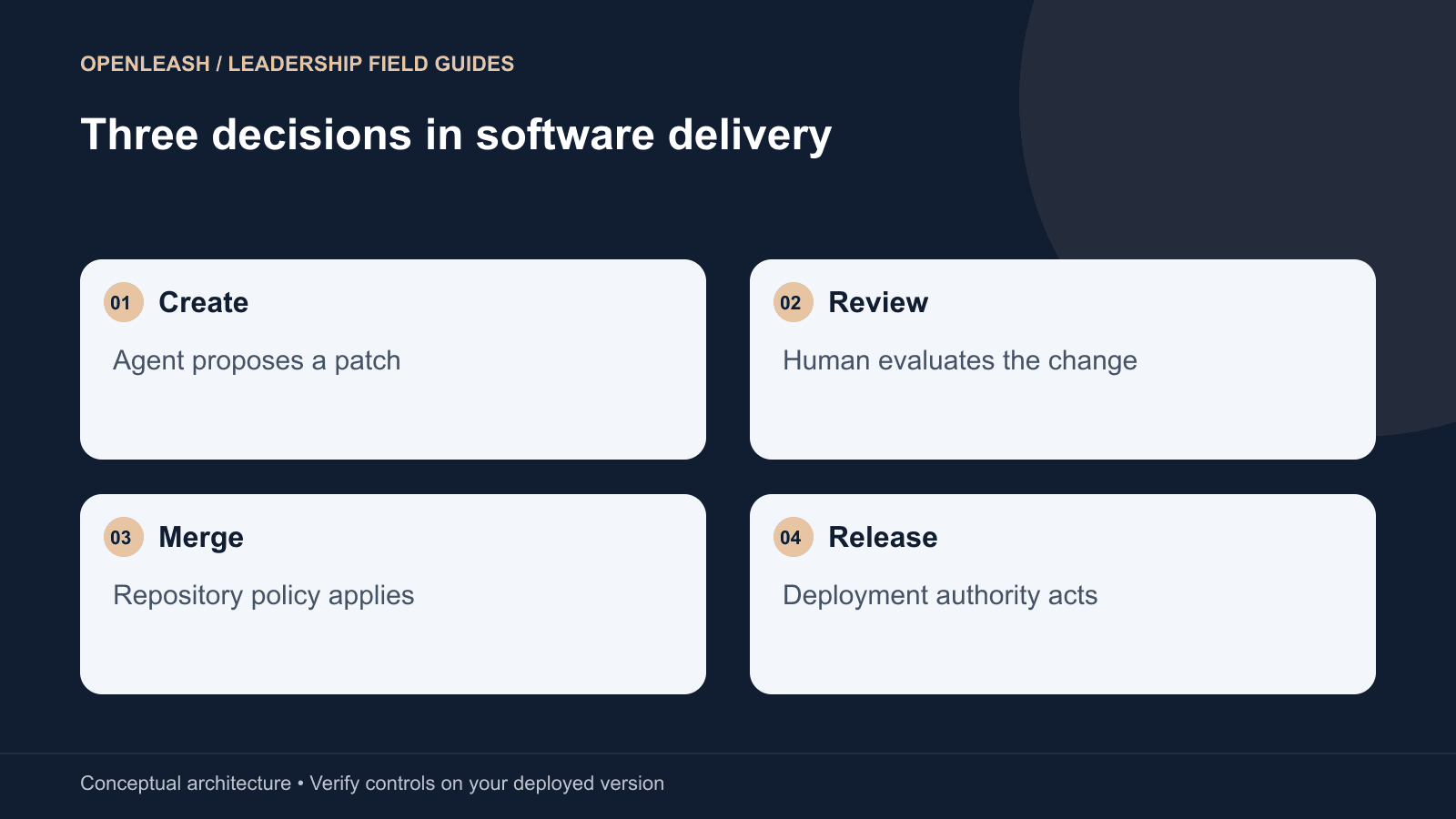
Ask engineering managers to trace one change from request to production. Who starts the task? Where do tools run? Which identity can push a branch? Can the same identity alter repository policy, approve the pull request, or change the release workflow? These questions expose concentrations of authority that a license inventory cannot show.
For the VP of engineering, the aim is to retain fast feedback without making the author the sole judge of its own output. For the CISO, it is to preserve evidence that a consequential change passed an independent boundary. The platform team should make those boundaries easy to use so developers do not need personal workarounds to finish ordinary tasks.
Distinguish native hooks from the wider delivery system
GitHub documents hooks for agent workflows as lifecycle integrations that can run custom logic at supported events. Hook capabilities and their availability depend on the particular Copilot environment. Treat the installed local CLI, the editor workflow, and hosted execution as separate validation targets rather than assuming an integration with one covers them all.
A hook can help govern an action exposed by an agent runtime. Repository protections and deployment permissions govern later actions in the delivery system. A successful local test does not demonstrate that a hosted task, a CI runner, or a release identity follows the same policy. Maintain that distinction in architecture diagrams and internal assurance statements.
This also changes procurement questions. Ask which administrative controls apply to your selected plans and execution modes, how they are distributed, and how drift is detected. Then validate the answer in the workflow your engineers use. The purchase decision and the deployment acceptance test should be connected, but neither substitutes for the other.
A hypothetical failure: a helpful patch weakens its own checks
Imagine an agent tasked with fixing a flaky build in a fictional service. It changes application code and also relaxes a failing security check in the workflow definition. The patch appears to solve the immediate problem. If the same automation can merge and release that change without independent review, the organization has allowed task completion to redefine the controls used to judge success.
The dangerous step may be a plausible edit rather than an obviously malicious command. A review process that looks only for destructive terminal operations will miss the governance issue. Changes to deployment workflows, access policy, test exclusions, and security configuration deserve attention because they change what future work is allowed to do.
Use a sample repository with a harmless mock workflow to test this scenario. Have the agent propose a fix that touches both application code and a protected control file. Confirm the proposal remains reviewable and that repository and release rules still require the intended human decisions. Do not weaken a live repository’s protections to demonstrate the point.
How Leash contributes to a Copilot rollout
Leash currently lists installable user-level hooks for supported Copilot CLI and VS Code events. Its published coverage also distinguishes provider routing: for Copilot, supported routing is applied through the launch environment rather than persisted as a general provider configuration. These are specific integration properties, not a claim of control over every product carrying the Copilot name.
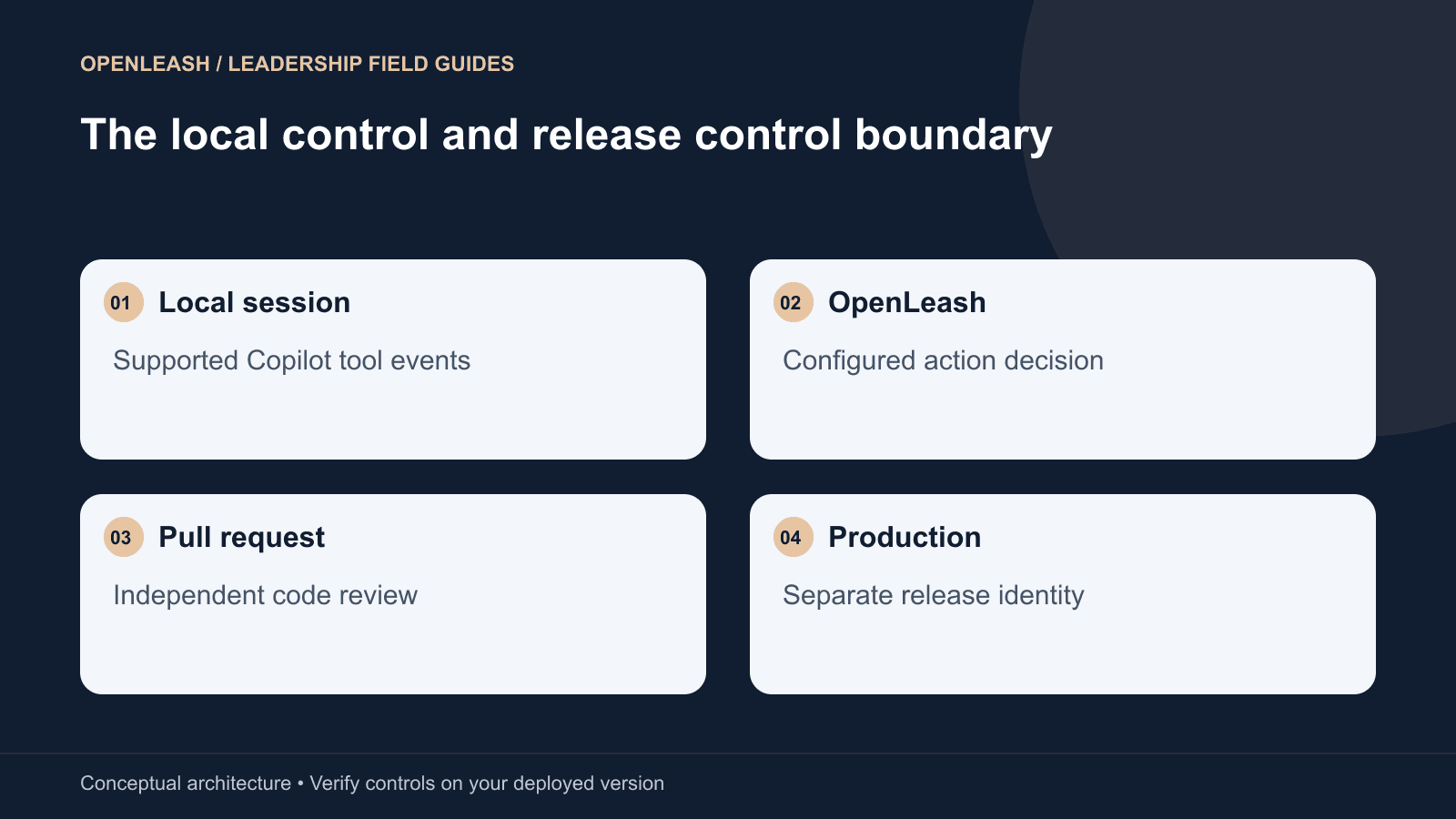
On a supported local path, Leash can add a configured decision before exposed agent actions, including requiring human approval where policy calls for it. Validate that behavior using the tools your team actually invokes. Record which launch path was used, because an environment-based configuration should not be assumed to apply to an unrelated session started another way.
Keep GitHub-hosted coding-agent jobs outside the asserted local coverage unless their execution path is separately supported and verified. Leash’s local action layer complements code review and release authorization. It should not be used as a reason to remove repository protections or allow the coding identity to administer its own safeguards.
Design a pilot around a complete pull request
Select a modest maintenance task with clear acceptance criteria: update a dependency in a sample service, add a small test, or correct a contained defect. Use a repository without customer data and an identity whose permissions stop at the intended development stage. The pilot should finish with a reviewable pull request, because a generated diff alone does not test the delivery workflow.
Before starting, agree on the files and actions that need additional scrutiny. Examples include publishing packages, pushing to a shared branch, modifying release configuration, and changing access controls. Choose a reviewer who understands the service and an escalation owner for policy questions. A security team that must interpret every routine code edit will become a bottleneck.
- Ordinary task: verify that allowed reads, edits, and tests complete and produce a useful patch.
- Publishing boundary: test a disposable destination and confirm the configured decision occurs before the supported publishing action.
- Control-file change: ensure the review process highlights changes to the sample release or policy configuration.
- Launch variation: repeat the relevant test through the actual editor and CLI launch methods in scope.
- Hosted comparison: document where a hosted job executes and which independent controls apply there.
- Failure handling: test unavailable approval in a safe environment and record the observed result before broader rollout.
Write a review policy that humans can actually follow
Require reviewers to evaluate both the functional change and the authority it affects. A patch can be correct in isolation while expanding access, changing a build’s secret exposure, or introducing a new outbound service. Review templates should ask a few concrete questions tied to those risks instead of adding a long generic AI checklist.
The authoring agent can summarize its work, but that summary is an aid rather than independent evidence. Review the diff and the test result. For higher-risk changes, require a service owner or specialist who was not responsible for generating the patch. Keep emergency exceptions explicit, time-limited, and reviewed after the incident.
Avoid making “AI-generated” the only trigger for serious review. Human-written changes can alter the same controls, and mixed authorship is difficult to classify reliably. A durable policy follows the effect of the change: authentication, deployment, data access, external publication, or service availability. This makes the process defensible as agent adoption grows.
Measure quality at the boundary where risk becomes real
Report time to a reviewable change, reviewer effort, escaped defects, and policy exceptions together. A faster draft can still increase total work if reviewers must reconstruct context or repair broad changes. Likewise, a longer approval queue may indicate poor task scoping rather than a need to remove the approval boundary.
For security reporting, distinguish an action stopped before execution from a concern found in code review and from a release blocked by deployment policy. Those are different outcomes produced by different controls. Combining them into one “AI threats prevented” number would make the report harder to interpret and the coverage harder to defend.
Use the pilot results to improve the workflow. If a class of low-risk tasks repeatedly needs the same approval, consider a narrow permitted path with a safe identity. If agents repeatedly touch sensitive configuration to satisfy tests, improve task instructions and review routing while retaining the control boundary. Expansion should follow demonstrated task quality, not the number of accepted suggestions.
The executive decision to make next
Should Copilot be allowed to deploy? Treat deployment as a separate use case with its own identity, service owner, and recovery procedure. The fact that an agent helped write the code does not establish that it should release it.
Does a working Leash local hook cover GitHub-hosted coding tasks? No such blanket conclusion follows. Verify each execution environment and describe unsupported paths clearly.
The most useful first decision is to authorize a bounded pull-request pilot with independent merge and release controls. Assign engineering ownership for productivity, security ownership for the risk standard, and platform ownership for the integration. That gives leadership evidence about both the value of Copilot and the boundaries needed to scale it responsibly.