NanoClaw security for leaders: contain the authority of a persistent messaging agent
 NanoClaw7 min readBusiness
A CISO and CTO guide to NanoClaw’s group boundaries, container isolation, credentials, and persistent tasks—with a version-aware Leash validation plan.
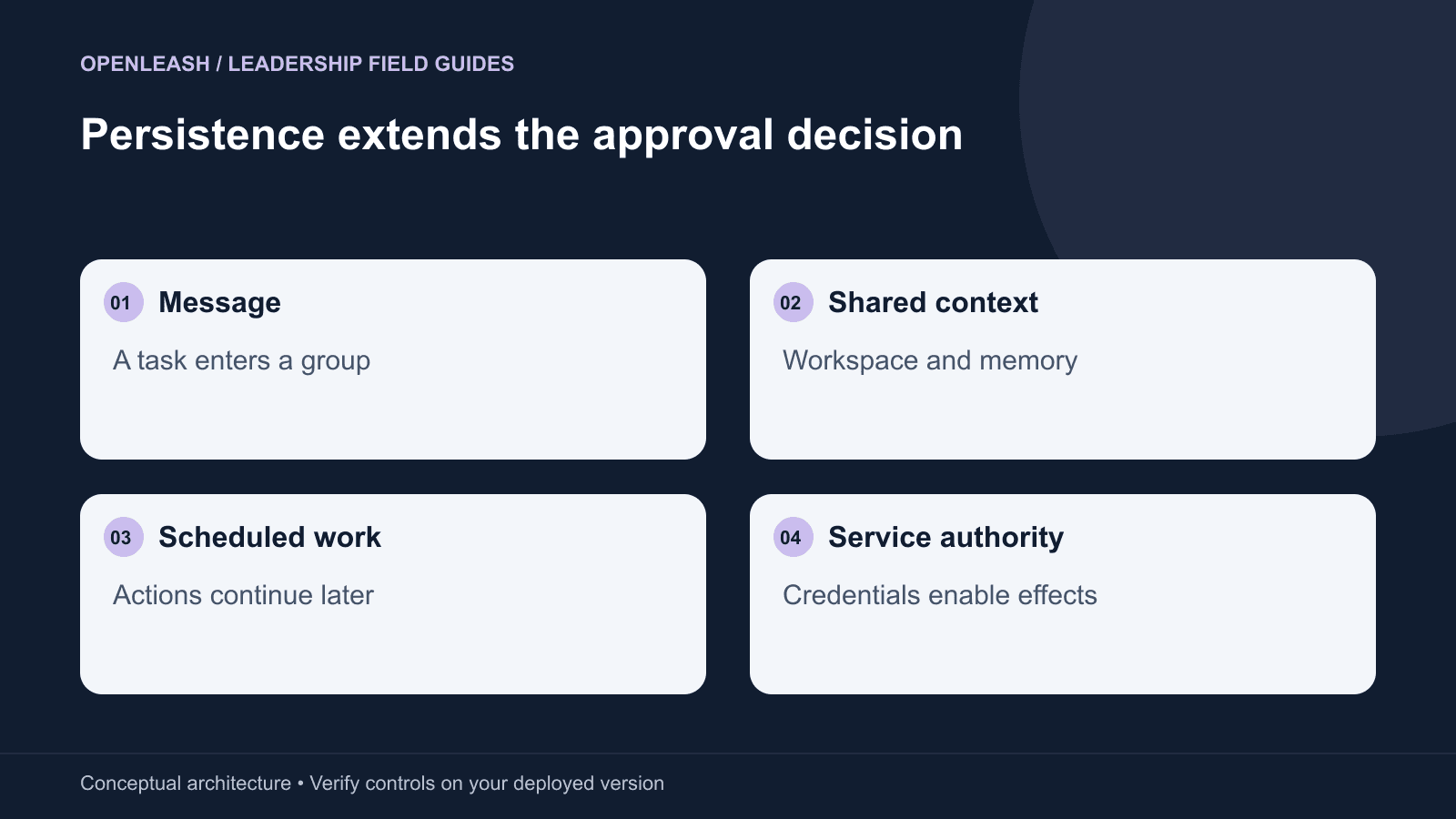
A messaging agent can remain useful after the person who configured it has left the conversation. That persistence changes the security question. Leaders need to govern the group’s accumulated context, the credentials available to its tools, and the scheduled work that continues between human interactions.
In this guide
Review the group as a small operational system
An executive may first see NanoClaw as a convenient assistant in a chat. The more useful governance model is a small operational system with inputs, memory, scheduled work, tools, and service identities. Its risk depends on that system’s business authority, not on the familiarity of the messaging interface.
Create one deployment record per business group or trust boundary. Identify who can contribute messages, what data is retained in the workspace, which services the tools can access, and which tasks run without a new request. Name an owner who can explain why the agent needs each capability and who can stop it when the original purpose changes.
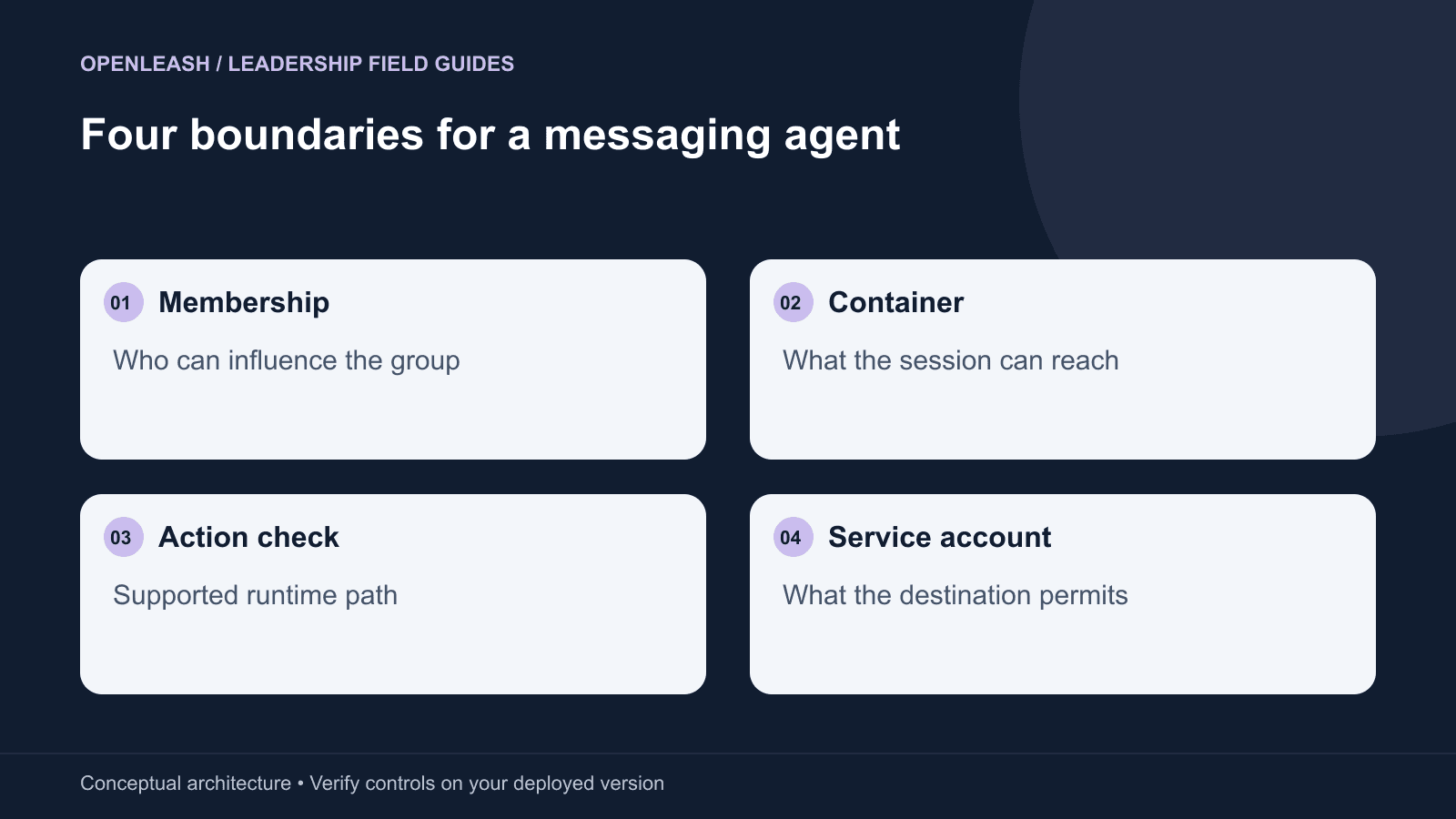
This is particularly important when a pilot moves from a personal assistant to a team workflow. People in the same channel may have different job responsibilities, and external content may enter through forwarded messages or documents. Membership is an authorization decision about who can influence the system; it should not be treated as an incidental collaboration setting.
Understand NanoClaw’s native boundaries before adding another layer
NanoClaw’s current security documentation describes per-session containers while a group’s workspace and memory remain shared. It also describes host-side credential handling through a vault/proxy architecture and optional egress restrictions. These are native NanoClaw capabilities, not features supplied by Leash. Their configuration and deployed version matter.
Container isolation limits particular forms of access; it does not decide whether an otherwise permitted business action is appropriate. A session can stay inside its container and still use an authorized service connection in an unwanted way. Likewise, a credential kept out of the container can still confer authority through the service that uses it on the session’s behalf.
Read the security documentation for the version actually installed, then verify the mounts, network behavior, and credential path in a safe environment. Avoid carrying assumptions from an earlier deployment into a newer architecture. The security review should describe observed boundaries and explicitly identify optional controls that have not been enabled.
A hypothetical failure: yesterday’s request becomes tomorrow’s action
Imagine a fictional operations group that asks its assistant to prepare a daily customer-status digest. The initial task is read-only and uses a test dataset. Over time, the group connects a live account and adds a step that posts the digest externally. The schedule persists, but nobody revisits the original authorization as the data and destination change.
The failure is not necessarily a malicious message. It is authority drift: a persistent task outlives the assumptions under which it was approved. Shared memory can make the workflow appear continuous even though its business effect has changed from internal analysis to external communication.
Reproduce this safely with a mock customer system and an internal test inbox. Change the scheduled task’s destination or data source and observe whether the workflow requires a fresh decision. The acceptance criterion is that a material scope change cannot silently inherit the old approval. If the runtime does not enforce that relationship, establish the boundary in the service account, publishing process, or task-management procedure.
How to evaluate Leash with NanoClaw
Leash’s published coverage lists a Claude-compatible hook path and automatic supported Claude-compatible base-URL configuration for NanoClaw. That describes an integration route, not a guarantee that every NanoClaw version, container launch mode, or tool operation crosses it. Validate the exact runtime composition before reporting the deployment as protected.
Trace a sample action from the message through the running session to the tool. Confirm that the supported hook reaches Leash and that a configured deny or approval decision affects execution as expected. Separately confirm the supported provider route where used. Keep evidence of the runtime version, container configuration, integration setup, and test outcome.
Leash can add an action decision on that verified path. It does not replace group membership controls, container isolation, credential scope, or the destination service’s permissions. If a scheduled operation or custom tool bypasses the supported path, document it as a coverage gap and constrain it independently rather than assuming that the agent’s name establishes coverage.
Start with one group and one low-authority workflow
Choose a task whose output can be inspected before it affects anyone else: summarize synthetic records, draft an internal update, or prepare a proposed checklist. Use a dedicated group and a limited service identity. Keep external publication and production writes outside the initial scope so the team can understand persistence and context without taking unnecessary business risk.
Document the group’s participants and the sources of content they may introduce. Separate instructions from data in the workflow design, while recognizing that formatting alone is not an enforcement boundary. A forwarded document can contain language that resembles an instruction; the service permissions and action checks must still constrain the resulting behavior.
- Membership test: verify who can initiate work and who can change the group’s configuration.
- Shared-context test: confirm what a new session can read from the group’s workspace and memory.
- Action test: use a harmless fixture to validate the supported Leash allow, deny, and approval outcomes.
- Schedule test: observe what happens when a task runs after its original requester is absent.
- Scope-change test: alter a mock destination and confirm the necessary new authorization occurs.
- Shutdown test: stop the task, revoke its test credential, and verify that delayed work cannot continue using the old authority.
Give every persistent task an operational owner
A schedule should have more than a descriptive name. Record the purpose, data sources, permitted destinations, service identity, frequency, owner, and review date. Include what should happen when inputs are missing or contradictory. A task that improvises around a broken dependency may reach beyond the workflow its owner intended.
Define who can change the task and who reviews changes that increase its effect. Moving from drafting to sending, from a test account to a live account, or from one group to several groups should trigger review. Preserve a simple way to pause work while an owner investigates, and test that pause against queued or recurring execution rather than only an active chat session.
When someone leaves the team, review the tasks they created along with their user access. A service identity can survive employee offboarding, and the schedule may continue even when the original person can no longer log in. The business owner should explicitly retain, transfer, or retire that delegated authority.
Plan incident response around both context and credentials
If an unwanted action occurs, stopping the visible conversation may be insufficient. The response team needs to identify active and scheduled work, relevant group context, service credentials, and downstream effects. Preserve the evidence needed to understand the sequence while containing the authority that could repeat it.
Use a tabletop exercise with a fictional external-posting error. Ask who can pause the task, revoke the service connection, inspect the destination, and notify the business owner. Distinguish an agent decision error from an excessive permission grant and from a gap in the integration path. Those causes require different fixes.
Report the time to stop scheduled work, the number of ownerless tasks, the age of scope reviews, and unresolved coverage gaps. These measures help a CIO judge operational readiness. Counting messages answered or tasks completed shows activity, but it does not show whether persistent authority remains intentional.
Questions to settle before connecting a live service
Does a container make the agent safe for any business workflow? No. Isolation and business authorization address different risks. Verify both before granting write access.
Does a NanoClaw deployment automatically inherit Leash coverage? No. The published integration uses a specific Claude-compatible path, and the installed version and execution route need validation.
The next step is to approve one group, one bounded task, and one limited identity, then test action control and shutdown. Expand only after the owner can explain what persists, what can change, and how the organization withdraws that authority. That is the difference between a useful assistant experiment and an operational service leadership can responsibly support.