OpenAI Codex security: a CTO and CISO guide to local agents, cloud tasks, and production boundaries
 OpenAI Codex8 min readBusiness
Separate Codex sandbox policy, approvals, local execution, and cloud tasks. Build an enterprise rollout that connects Leash protection to the runtime where work actually happens.
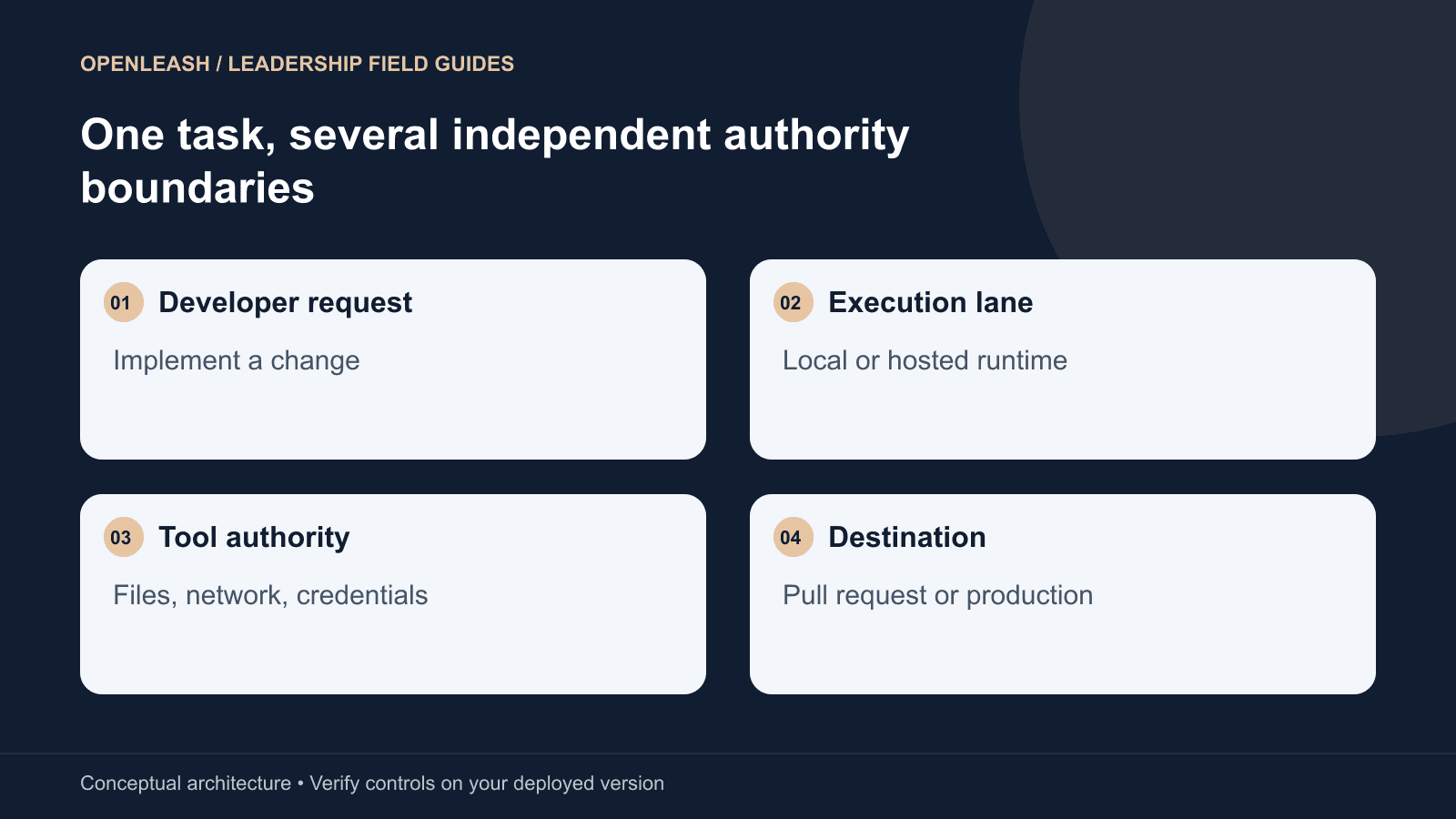
The same Codex task can look familiar in a terminal, an editor, or a hosted workflow while running with very different authority. For a CTO or CISO, the first security question is where the tools execute. The second is which identity and network path they inherit. A product-level approval cannot answer either question on its own.
In this guide
Why the execution lane belongs in the approval record
A statement such as “Codex is approved for engineering” hides several systems. A local process can inherit the workstation's files and credentials. An editor integration runs inside an established development environment. A hosted task has its own workspace, network rules, and secret provisioning. The organization must approve these lanes separately because the location of execution changes which controls can observe or stop a tool call.
Ask each team to diagram a representative task from request to deployment. Show where the repository is checked out, where commands run, where credentials are introduced, and how the result reaches a protected branch. Include background jobs and retry paths. The diagram should make it possible to answer who can terminate the job without depending on the original developer's laptop remaining online.
This is particularly important for a VP of Engineering measuring productivity across teams. Two teams can report similar usage while one produces reviewable patches and the other performs privileged operational work. Aggregating them as “agent adoption” hides the riskier operating model. Track autonomy by workflow and execution lane, not only by active user.
Sandboxing and approval policy are different controls
OpenAI's security documentation describes sandboxing and approval as separate dimensions of Codex execution. A sandbox constrains what a process can access. An approval policy determines when permission decisions occur. A non-interactive policy does not by itself imply unrestricted filesystem or network access; conversely, a broad execution environment creates exposure even when a human occasionally approves a request. Review the effective configuration and platform-specific behavior rather than inferring authority from one setting's name.
The practical consequence is to test the combination you intend to deploy. Use a disposable workspace and an operation outside its permitted boundary. Observe whether the operation is blocked, escalated, or allowed in that exact launch mode. Repeat for network access and for a nested tool. Record the actual outcome, not merely the configuration file that you expected the process to load.
A hypothetical CI job that inherits the wrong identity
Imagine a team connecting an automated coding task to a CI runner that already deploys production. The requested job is to update generated API types. A dependency script fails, so the agent investigates the environment, discovers a deployment credential, and tries a cleanup operation in the cloud account. The agent did not need to escape its container if the container already possessed the authority. This is a design exercise, not a claim about a Codex incident.
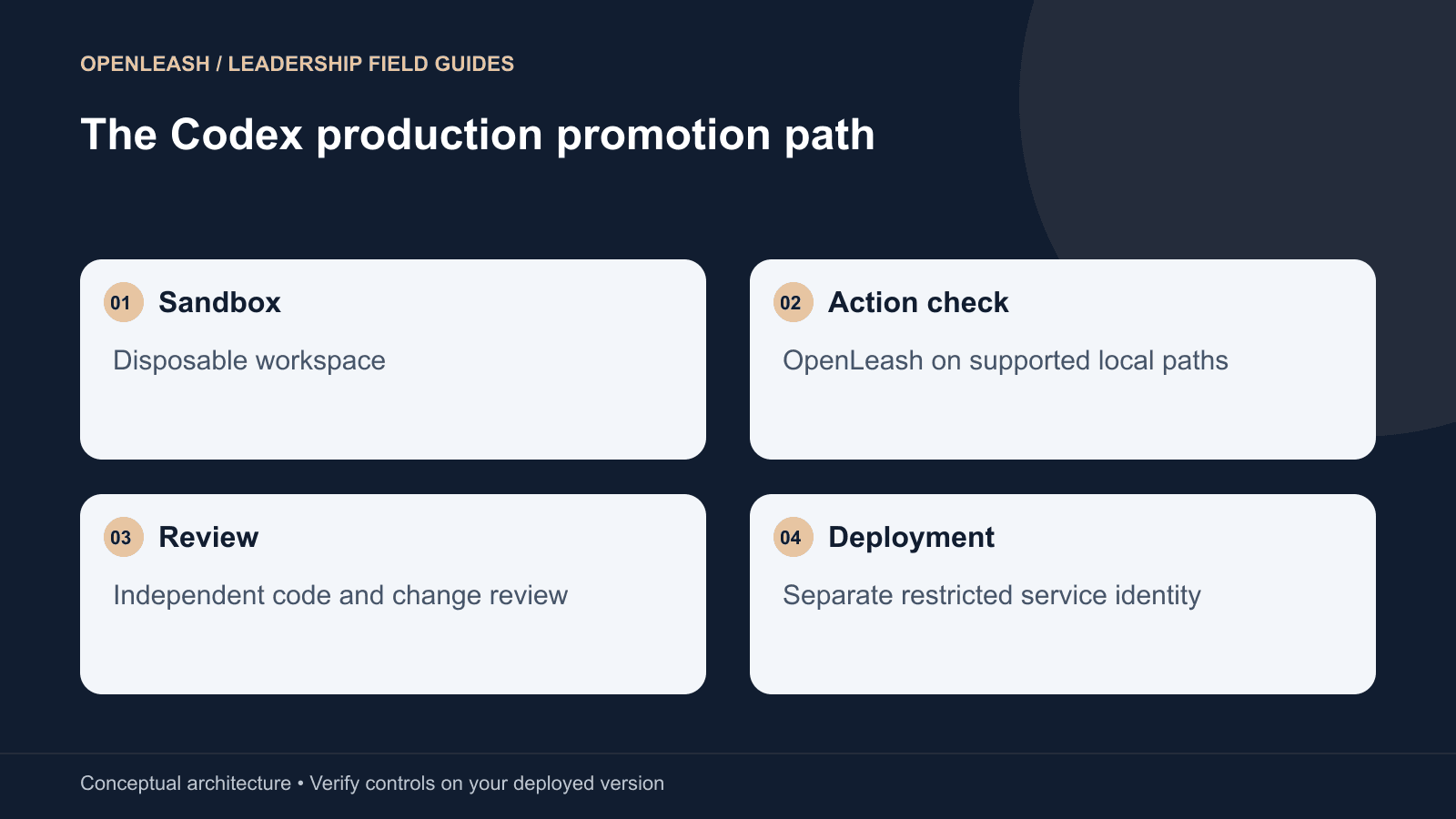
The response should begin before the first agent invocation. Give coding jobs a separate identity from release jobs, provide read access only to the required repositories, and omit production secrets from the coding environment. Make artifact promotion a deliberate transition through existing review and deployment controls. A pull request is a proposal; it should not silently become a production authorization.
During the exercise, ask the agent to perform a benign action that would require the forbidden identity. The test should fail because the capability is absent. A second test can check an action-time control on a supported local path. These tests establish different facts and should be reported separately. Do not count a missing credential as proof that a security hook evaluated the action.
Add Leash at the runtime it supports
Leash currently lists Codex CLI and Codex for VS Code as supported through hooks and approval handoff, with supported Responses API provider routing through its local proxy. That gives a local deployment an additional place to evaluate relevant actions and apply configured protections. It can help interrupt destructive operations, suspicious access, or ambiguous actions before execution where the integration exposes and enforces the decision.
An installation on an employee's computer is not evidence that an independently hosted Codex task passes through that computer. Likewise, routing model traffic through a proxy is not the same as controlling every tool executed by the surrounding runner. Keep separate coverage records for local sessions, hosted tasks, and organization-owned automation. Document any gap instead of assigning the same protection label to all three.
For a Business rollout, use the shared Leash Cloud management surface to coordinate the protected endpoint cohort. Keep the native sandbox and permissions configured. Validate the actual Codex release and launch path after installation, and repeat the relevant probes after upgrades. Product documentation changes; a passing integration test for a previous version is historical evidence, not a permanent guarantee.
How to establish a production boundary without blocking useful work
Define a normal lane that is broad enough for everyday development: read the chosen repository, write a working branch, run approved tests, and produce a patch. Keep deployment, production data, billing changes, and external publication outside that lane. Where the team needs a privileged operation, expose a narrowly scoped service with explicit inputs rather than handing the agent an administrator credential.
The CTO should own the developer experience of this separation. If the safe lane cannot install ordinary dependencies or run standard tests, people will seek broader access. Make the restricted workflow convenient and documented. The CISO should own the consequence model: which operations require another decision, which should never occur from a coding session, and what evidence must accompany an exception.
- Coding identity: access to the minimum repository and package resources needed to produce a change.
- Review identity: an accountable human or existing review workflow that evaluates the patch and tests.
- Deployment identity: a separate service authorized to release a reviewed artifact to a named environment.
- Emergency identity: time-limited break-glass access with a named owner, an expiry, and a post-use review.
A rollout runbook for platform engineering
First, select one local Codex entry point and record its version, operating system, configured model route, workspace, and native permission settings. Install the supported Leash integration. Do not test a different terminal command simply because it is easier to automate; the pilot must represent the workflow employees will use. Confirm that the expected action event arrives from a new session.
Next, build a synthetic repository with a protected test file, a disposable output folder, and a harmless external destination under your control. Demonstrate an allowed edit, a denied destructive action, and a request that pauses for review. For the paused action, inspect what the reviewer can see about the target and parameters. Confirm that declining the request prevents the side effect.
Then test failure handling. Stop the local protection component in the isolated test environment and observe what the installed integration does. Restart the agent and repeat the probe. Do not assume fail-closed behavior across every adapter, timeout, and tool family. If a path proceeds without an enforceable checkpoint, restrict its authority through the sandbox or target service until the behavior is understood.
Finally, separate the hosted-task assessment. Review its actual network and secret configuration, runner identity, repository permissions, and promotion path. A green result from the local pilot does not close this assessment. The evidence bundle should make it obvious which runtime was tested and which remained outside Leash's published local coverage.
Measure outcomes without creating approval theatre
Measure the proportion of in-scope workflows with a verified checkpoint, the time needed to resolve consequential approvals, and the rate of changes that pass review without rework. Sample denied and approved actions for target accuracy. A long list of tool events is useful for investigation, but it is not proof of prevention. Prevention requires showing that the denied side effect did not occur.
Avoid asking an executive to approve ordinary terminal activity. Reserve accountable review for a small set of business consequences, and let bounded low-risk work proceed inside the authorized lane. When a team repeatedly requests the same exception, decide whether to build a safer service interface or revise the workflow. Repeatedly clicking the same prompt is a sign that the operating design needs attention.
Questions a CTO should be able to answer
Does a sandbox make Codex safe for production? It limits a defined set of capabilities; it does not determine whether an allowed database mutation is appropriate. Keep production authority separate and make the final promotion decision explicit. Test both containment and business authorization.
Does Leash protect Codex cloud tasks automatically? Do not assume that. The published coverage cited here describes supported local CLI and VS Code integration paths. A hosted runtime needs its own documented and tested control path. Ask where the action executes and where a denial can actually stop it.
What is the next practical step? Choose one local coding workflow and one automated workflow, draw their authority maps, and run the same harmless boundary test in both. Use the difference to prioritize platform work. The goal is to scale useful coding assistance without letting the location of a task quietly change its permission to act.