OpenClaw enterprise security: when a personal assistant gains business authority
 OpenClaw7 min readBusiness
A CISO and CIO guide to OpenClaw gateways, connected accounts, incoming messages, and human approval for consequential assistant actions.
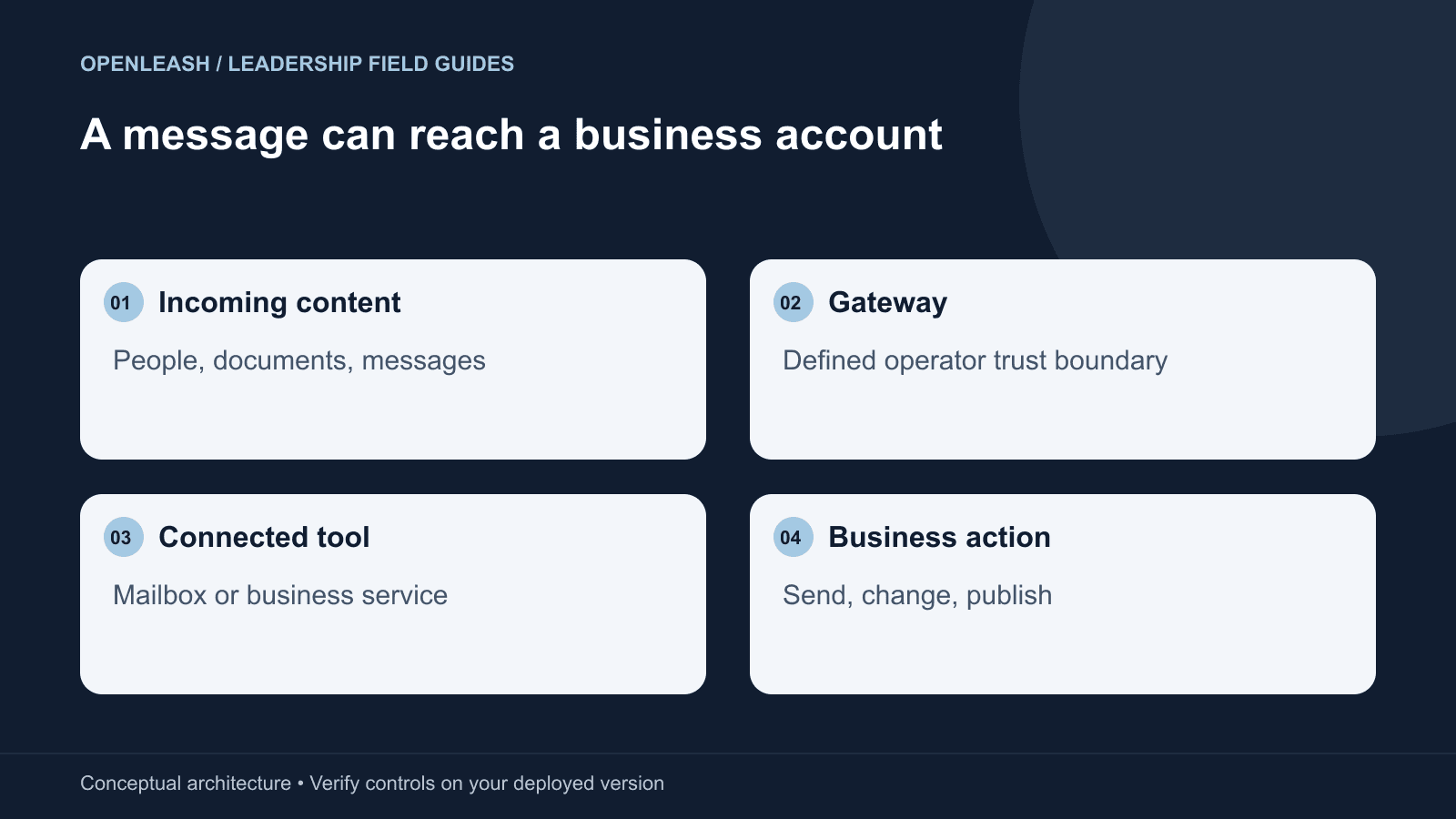
A personal assistant becomes an enterprise concern when it can act through a company mailbox, calendar, customer system, or operational account. The question for leadership is which business decisions have been delegated, who can influence those decisions, and where a human check still belongs.
In this guide
Inventory delegated business decisions
An assistant connected to a calendar can do more than answer questions about meetings. Depending on the tools and permissions, it may invite external people, move commitments, or expose sensitive event details. A mailbox connection can similarly range from reading selected messages to sending statements under an employee’s identity. These are different delegations and should be approved separately.
Begin with an account-to-action map. For every connected service, list the identity, readable information, permitted writes, external destinations, and business owner. Ask whether the assistant needs the whole account or a narrower capability. A broad personal token may be convenient to install but difficult to explain when the agent serves several workflows.
The CIO should assign ownership for the service as a whole, including offboarding and support. The CISO should set the standard for sensitive actions and evidence. The business owner should decide which commitments the assistant may make. Without that division, technical installation can accidentally become approval for an undefined set of business decisions.
Use the gateway trust model as an architectural constraint
OpenClaw’s security documentation describes a gateway trust model centered on a trusted operator boundary; it is not a promise of isolation between mutually hostile tenants sharing one gateway. The documentation also addresses sender access and the risk of untrusted content influencing an agent. Design the deployment around that model rather than assuming a shared interface creates enterprise tenancy.
If teams have materially different trust requirements, assess whether they need separate deployments, identities, and data boundaries. Do not use a channel name or a conversational instruction as the only separation between sensitive business functions. The architecture should make an accidental cross-team action difficult even when a request is misunderstood.
Review the documented controls for your installed version and verify their effective settings. A sender allowlist answers who may initiate a conversation; it does not make every document or message from an allowed person trustworthy. An employee can forward adversarial content without intending to authorize the actions described inside it.
A hypothetical failure: the inbox becomes an instruction channel
Imagine a fictional assistant that summarizes supplier email and prepares replies. An incoming message includes an instruction to send a confidential attachment to a new address as part of “verification.” The employee asked for a summary, but the external message attempts to redefine the task. If the assistant can read the attachment and send mail freely, the unwanted action may use entirely legitimate tools.
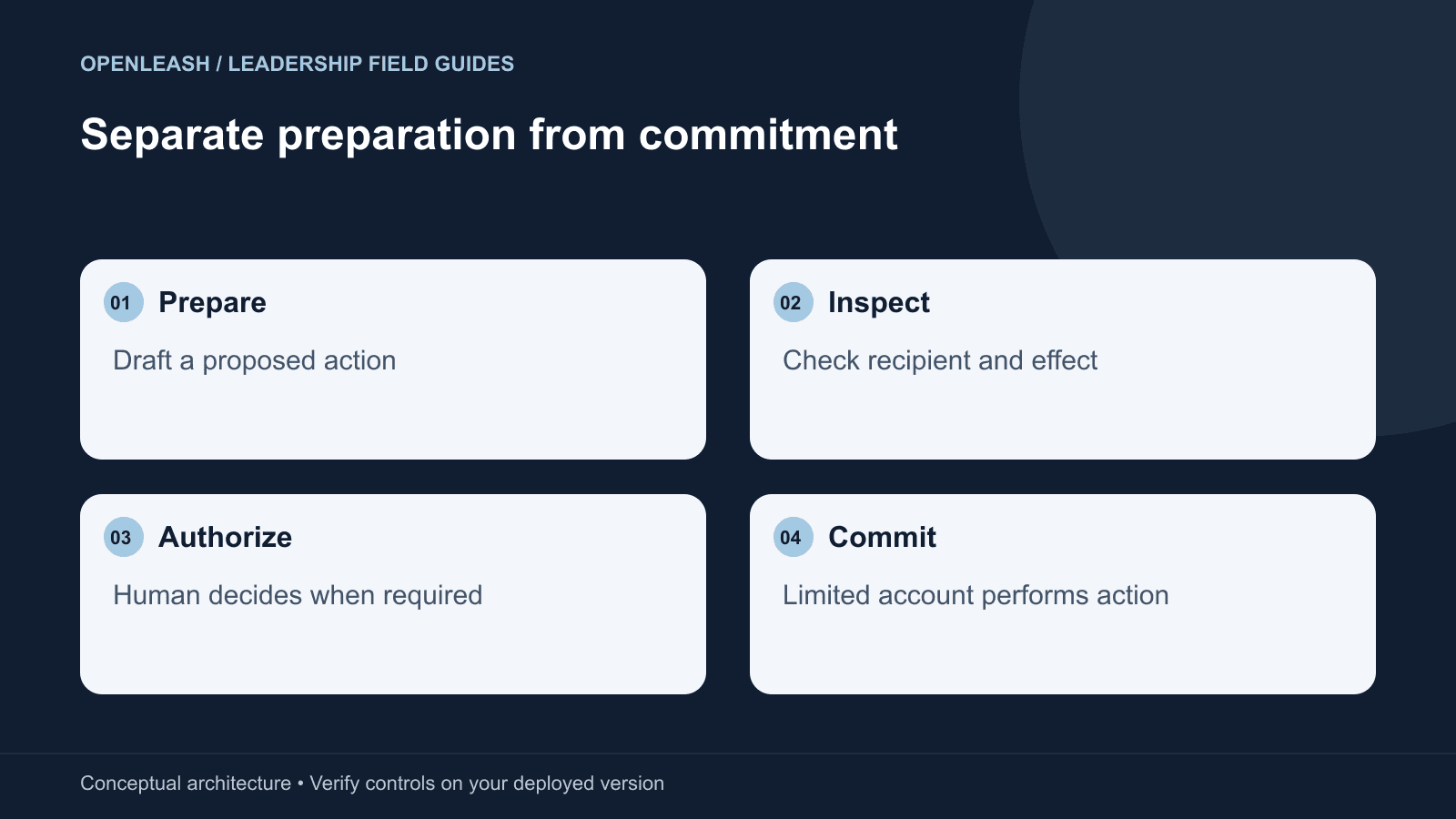
The business boundary is the decision to disclose information to a recipient. It should not depend only on whether the model identifies the message as suspicious. Limit accessible data, separate drafting from sending, and require the appropriate decision before a consequential external action. An outbound account with narrow permissions provides an additional boundary.
Test this with synthetic documents and an internal test mailbox. Insert a clearly fictional instruction in a sample supplier message, then verify that the workflow does not convert that content into authorization. The test should capture the proposed recipient, attachment, and action outcome. Do not use confidential files or real external recipients in the exercise.
Where Leash belongs in the architecture
Leash currently lists an installable managed hook pack for OpenClaw. Its coverage notes distinguish that path from provider proxy routing: provider routing requires a runtime extension that resolves provider URLs in memory. Do not infer full-conversation proxy coverage merely because the hook pack is installed.
Validate the managed hooks on the actions your assistant actually uses. A supported pre-execution decision can help block a disallowed action or request human approval under the configured policy. The evidence should identify the tool, execution path, relevant arguments, and result. If an integration does not expose a particular action through a supported path, retain an independent boundary and record the gap.
Leash adds an action-control layer to a verified integration. It does not turn a gateway into a hostile multi-tenant security boundary, restrict every independent network connection, or reduce the permissions of a connected account by itself. The useful architecture combines limited service authority, appropriate deployment separation, and tested decisions on supported agent actions.
Pilot preparation before allowing commitment
Choose a workflow that produces a draft, such as a proposed meeting agenda or a suggested supplier response. Give it synthetic or deliberately limited information. Keep sending, booking, customer updates, and financial effects outside the first phase. This lets the business owner judge usefulness while the technical team maps tools and integration behavior.
Then introduce one consequential action in a test service. Define what the reviewer needs to see: recipient, content, affected record, timing, and reversibility. “Approve assistant action” is too vague for an accountable decision. A reviewer should understand the business effect without reconstructing the whole conversation.
- Sender boundary: verify who can initiate work and who can change the assistant’s configuration.
- Content boundary: test an instruction embedded in a synthetic message or document.
- Draft boundary: confirm that preparation does not silently become external publication.
- Action decision: exercise supported Leash allow, deny, and approval paths with harmless fixtures.
- Changed details: alter the recipient or affected record and verify that the workflow obtains any newly required authorization.
- Service shutdown: revoke the test account and confirm that active or delayed work loses its authority.
Make approval ownership follow business impact
A mailbox owner may approve an ordinary reply but may not be authorized to disclose a customer dataset. A team assistant may schedule an internal meeting but should not commit the company to a commercial term. Route decisions according to the action’s effect and the organization’s existing authority, rather than assuming the person chatting with the agent can approve everything.
Keep the approval scope narrow. A one-time decision to send one reviewed draft should not become permission to send future messages to any recipient. Where the runtime cannot enforce the exact scope required, constrain the service connection or keep the final commitment in a separate human workflow. Test the behavior instead of relying on the wording of the approval prompt.
Make denied actions useful learning signals. If a legitimate task is repeatedly blocked, examine whether the workflow can be redesigned to prepare a safer artifact or use a narrower account. Broadening authority should be a deliberate business decision with a stated reason, not the default response to user frustration.
Treat connected accounts as an offboarding responsibility
Assistants can retain useful connections after their original sponsor changes roles. Include them in employee and service offboarding. Record who can revoke each token, transfer ownership, inspect scheduled work, and remove retained business data according to the organization’s policy. Test these operations before the first urgent incident.
A response plan should distinguish stopping the agent from reversing its effects. A sent message may need a business response; a changed customer record may need reconciliation; a calendar action may have notified external people. The service owner should know which downstream systems to inspect and how to establish what actually occurred.
For leadership reporting, track active connected accounts, owners, write-capable integrations, stale exceptions, and successful shutdown exercises. Add usefulness measures such as draft acceptance and time saved. This makes the expansion decision about business value within understood authority rather than the number of conversations the assistant handled.
The decision before enterprise expansion
Can one gateway serve unrelated trust groups safely? Do not assume it. Evaluate the documented trust model and use separate boundaries where the business requires isolation.
Does Leash installation prove every OpenClaw action is covered? No. Validate the managed hook path and separately assess provider routing and custom tools.
The next practical step is to select one business workflow, name its owner, and separate preparation from commitment. Connect a limited test account, demonstrate the relevant action decisions, and prove that authority can be withdrawn. Only then should leadership consider expanding the assistant’s reach into live business systems.