Windsurf and Cascade security: an enterprise playbook for terminal autonomy
 Windsurf7 min readBusiness
A CISO and VP engineering guide to Windsurf/Cascade terminal workflows, command policy, upgrade validation, and Leash’s current detection-only coverage.
An agent-enabled editor can turn a short request into a sequence of commands. The enterprise challenge is to govern the effects of that sequence while preserving a useful development experience. Leaders should evaluate the real scripts, credentials, and destinations involved, not just the command text displayed in the editor.
In this guide
Evaluate the command’s effect, not its familiarity
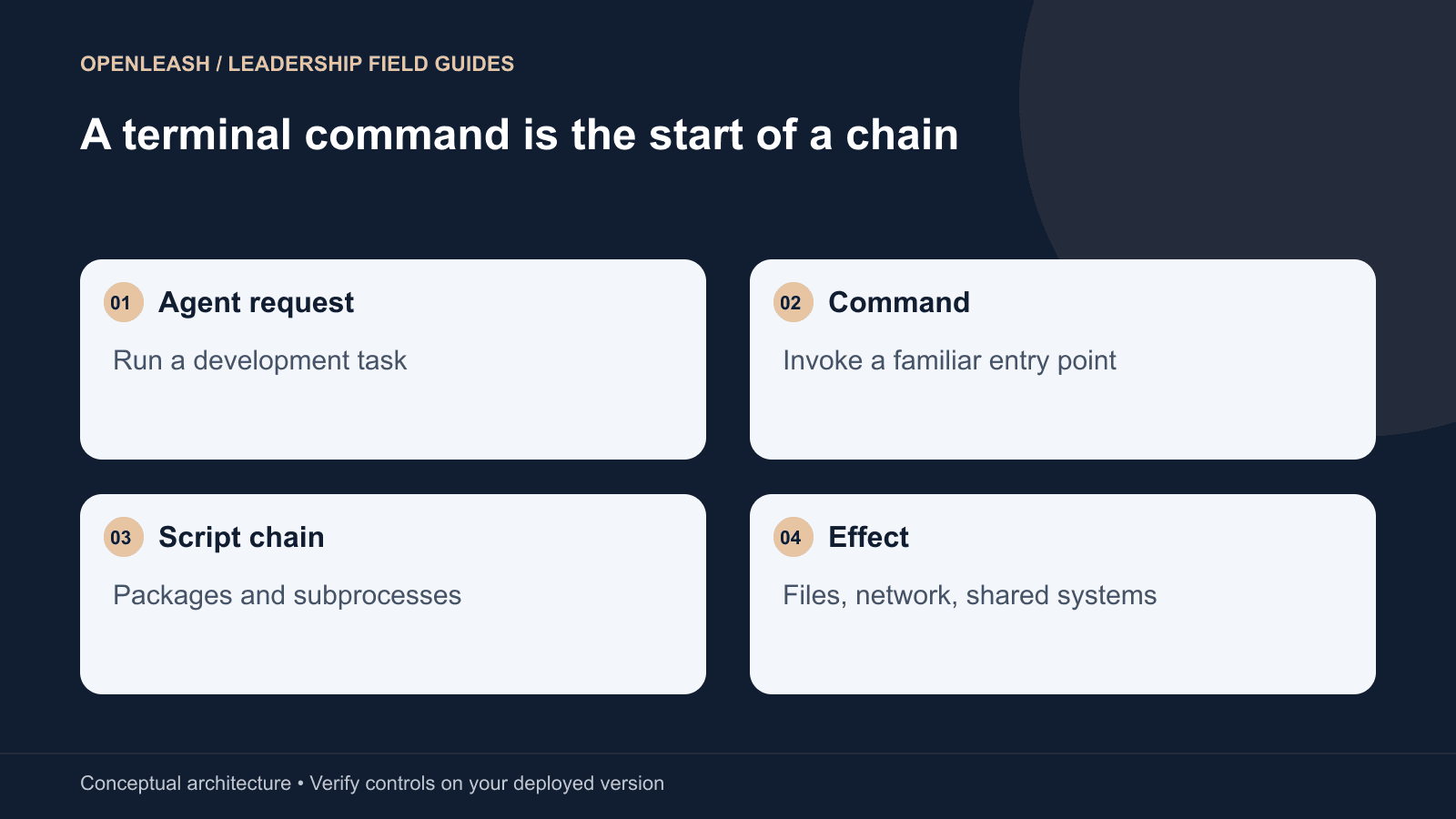
A terminal command can look routine while invoking a complex chain of scripts. A package manager may run lifecycle code. A build task may fetch remote resources. A deployment helper may select an account from the environment. An enterprise policy that recognizes only the first command word can overlook the authority exercised later in the chain.
Ask a pilot team to trace several real development tasks from the editor to their final effects. Record the scripts, subprocesses, network destinations, and credentials used. Include the working directory and configuration that influence the command. This exercise often reveals that the surrounding workstation matters as much as the agent’s visible settings.
For the VP of engineering, the goal is a supported workflow that completes useful work without unnecessary interruptions. For the CISO, it is a defensible boundary around consequential effects. The platform team can connect those goals by providing limited development environments and keeping publication or production changes in separately governed processes.
Verify the native terminal controls for the deployed version
The official Windsurf terminal documentation describes controls around command execution and approval. At the time of this review, the Windsurf documentation URL redirects to Devin Desktop documentation. Treat that transition as a reason to verify the installed product and applicable documentation, not as evidence that older Windsurf/Cascade deployments or other products share identical behavior.
Record the exact version, terminal settings, and administrative distribution method used by your organization. Test the behavior rather than relying on a remembered setting name. A product update or migration can change the configuration surface, supported modes, or execution path that your original assessment covered.
Native command policies are part of the control stack. They do not reduce the permissions of a cloud account, protect every downstream service, or establish that a script is harmless. Keep independent file, credential, network, and release boundaries appropriate to the workflow. The acceptance test should show how the layers work together on the installed deployment.
A hypothetical failure: a familiar build gains an external step
Imagine a fictional repository whose build task normally compiles local code. A dependency or script update adds a diagnostic upload. The agent runs the familiar build to validate a legitimate change, but the workflow now sends information to a destination that was never part of the original approval.
The risk comes from changed behavior behind an established entry point. It does not require the agent to invent a suspicious-looking command. A broad exception for the build workflow may continue to apply even though its effects have expanded. Reviewing executable configuration and constraining destinations reduces the chance that familiarity is mistaken for authorization.
Use a sample repository and a local mock receiver to test this safely. Add a clearly marked synthetic upload step and observe the native approval behavior and environmental restrictions. The outcome should identify which control notices or limits the new effect. This is a hypothetical test of your architecture, not a claim that a particular Windsurf release has a demonstrated vulnerability.
Describe Leash’s Windsurf coverage without ambiguity
Leash currently lists Windsurf as detection-only. The published coverage does not provide an installable action-protection path for Windsurf. Detection can help identify agent presence, but it does not mean terminal commands are intercepted, blocked, or sent through Leash human approval.
Keep this distinction visible in the enterprise inventory. A discovered application, an approved use case, and a verified enforcement integration are separate states. Leash can help establish the first and can protect supported paths for other agents, but those capabilities should not be generalized to Windsurf or to a newer product because documentation or branding has changed.
If Leash action enforcement is required for a sensitive workflow, treat the integration gap as an explicit acceptance issue. Use independently verified native and environmental controls for a bounded pilot, or choose an agent with a suitable supported integration for that workflow. A truthful gap with an owner is more useful than a broad protection label that cannot be demonstrated.
Build a representative terminal test suite
Choose ordinary tasks your team performs every day: install dependencies in a disposable project, run tests, inspect a diff, and create a proposed patch. Keep production credentials and real customer data outside the test environment. The purpose is to evaluate behavior under realistic task structure with harmless consequences.
For each case, define the expected result before running it. Some tasks should proceed, some should require a native human decision, and some should fail at an independent access boundary. Capture the observed behavior and the exact configuration. A screenshot can document the user experience, but the test also needs evidence about whether the action actually occurred.
- Normal workflow: complete an edit-and-test cycle and measure interruptions and output quality.
- Wrapper workflow: repeat a consequential fixture through the actual script or helper developers use.
- Destination change: point a sample operation at an out-of-scope mock target and verify the boundary.
- Credential isolation: confirm the session cannot use unrelated administrative identities.
- Version change: rerun the relevant cases after an editor update or migration.
- Coverage record: explicitly state that Leash detection does not provide Windsurf action enforcement.
Give developers a safe path to higher autonomy
A useful low-risk lane should be easy to enter and sufficient for common tasks. Provide a disposable or limited workspace, a known tool set, and a clear output such as a patch for review. Avoid requiring developers to bring broad personal credentials just to run routine tests.
For work that needs a shared service, provide a scoped identity and an explicit target. For production changes, preserve the organization’s deployment and change-control process. This separates the ability to prepare work from the authority to apply it. It also makes the agent workflow more predictable for developers because the boundaries are tied to effects they understand.
When a native approval prompt is too frequent, inspect the task design and available authority before broadening an exception. A narrow allowed workflow may be reasonable in a constrained environment. The same exception on a workstation with production access may be a materially different decision. Document the environment assumptions so the permission policy is not copied into a context it was never meant to cover.
Treat upgrades as focused control changes
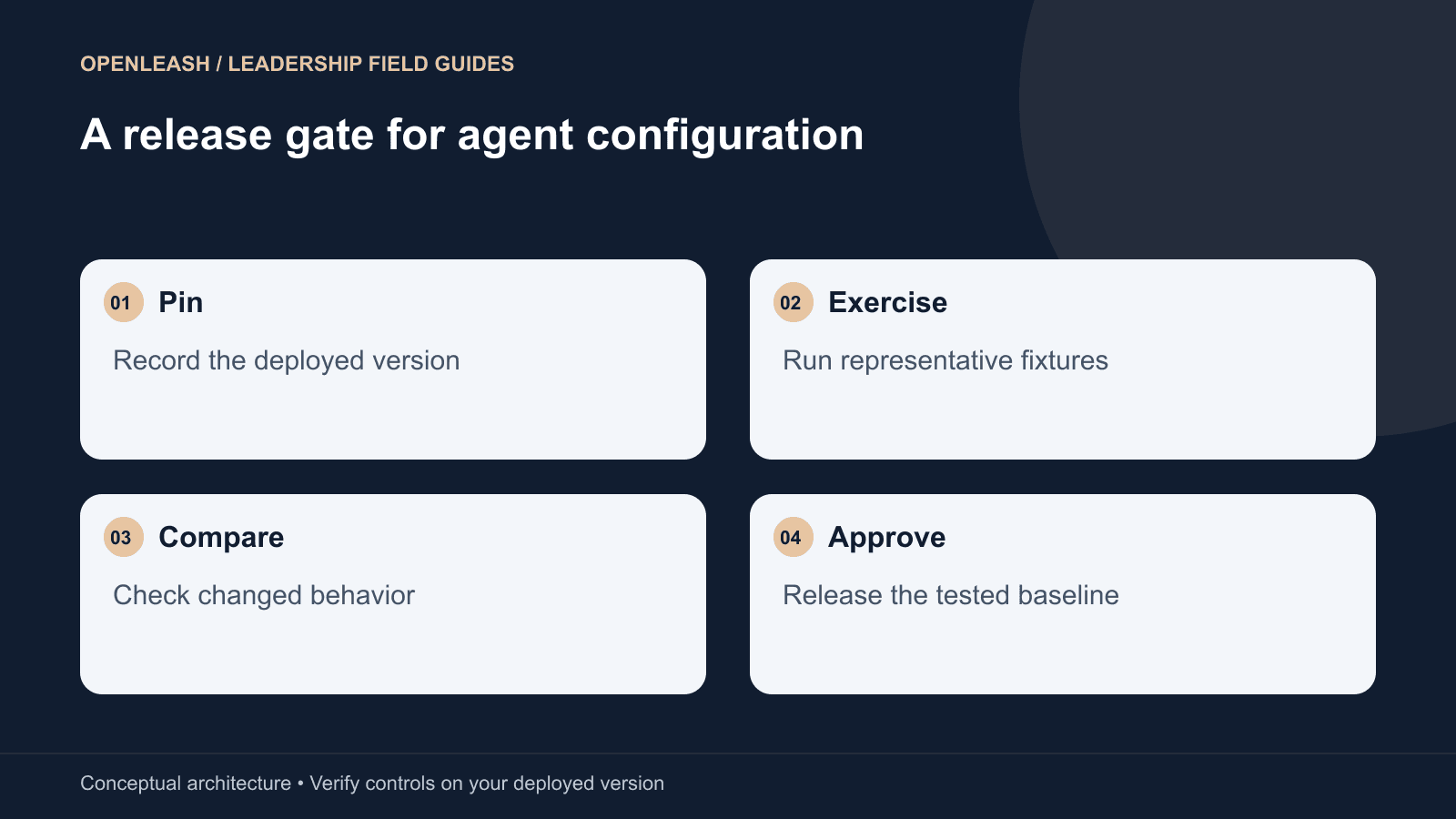
Fast-moving developer tools make a one-time assessment insufficient. Maintain a supported version record and a short set of representative tests. When the product changes, compare the execution behavior and effective settings with the previous baseline. The review should be focused on the changed boundary rather than repeating every procurement question.
Include documentation transitions and product migrations in that process. A redirected help page is useful for finding current information, but it does not prove compatibility with the organization’s installed fleet. Confirm which administrative controls, integrations, and launch paths apply before expanding the rollout under a new product version or name.
Keep a rollback procedure for the approved configuration where operationally feasible, and define what happens if a required control no longer behaves as expected. The team may need to pause a specific high-authority workflow while continuing ordinary development. This is easier to manage when sensitive tasks were separated from the beginning.
Report the evidence leadership needs
Show task completion quality, reviewer effort, configuration drift, approval friction, and the status of independent access boundaries. Distinguish a command stopped by a native policy from an operation rejected by a service identity. Both can be valuable, but they demonstrate different protections.
Does Leash currently enforce Windsurf actions? No. Its published Windsurf coverage is detection-only. Keep that limitation explicit until a supported integration is released and validated for your deployment.
What should the CISO and VP of engineering do next? Select one representative terminal workflow, remove unnecessary authority, verify the native controls, and preserve an independent release boundary. Publish the tested version and its limits. That gives the team a practical way to adopt agent-assisted development while making the remaining integration requirements visible and actionable.